Is a latex foam pillow better than memory foam?
Updated .
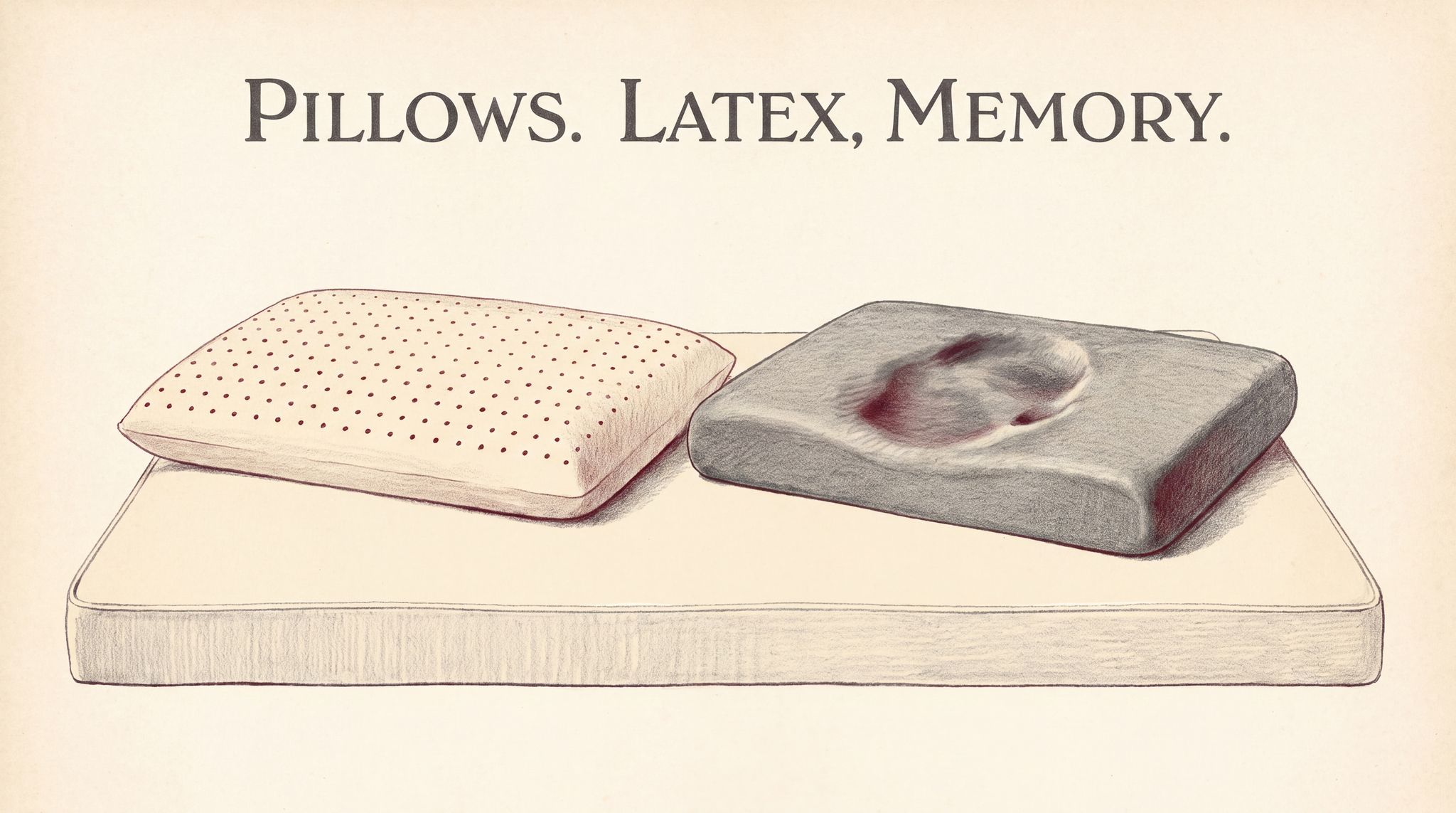
A latex foam pillow and a memory foam pillow can look alike on a shelf, but they behave very differently under a sleeping head. Latex pushes back at once. Memory foam softens and sinks slowly, holding a head-shaped dent for a few seconds. The trial evidence favors latex by a small margin, and the rest of the choice comes down to allergy, size and feel.
Short answer: On neck pain, the evidence leans slightly toward latex. A 2021 meta-analysis of nine high-quality studies with 555 people found rubber (latex) pillows reduced neck pain, though the effect was small (Chun-Yiu et al., 2021). Memory foam suits people who like a slow, sinking feel. It is also the safer pick for anyone with a latex allergy, which a 2016 review put at 4.3% of the general population (2016 review). Whatever the material, the height has to fit you.
This guide is for: people choosing between a latex foam pillow and a memory foam pillow, including anyone weighing a solid Dunlop latex pillow against a Talalay or foam one.
Key Takeaways
Three findings carry most of the decision: what the trials show, how solid latex pillows are sized, and who should avoid latex.
- Latex has a small edge in the trials. A 2021 meta-analysis pooled nine high-quality studies with 555 participants and found rubber pillows reduced neck pain, with a standardized mean difference of -0.263 (Chun-Yiu et al., 2021). That is a small but measurable effect.
- Solid latex pillows rarely match a 20 by 26 inch case. Of 13 seller pages we read, the 5 that gave full dimensions listed lengths of 23.6 to 27 inches (Talatex) and widths of 15 to 16.5 inches (Avocado), so expect a loose fit.
- A latex allergy rules latex out. A 2016 review put latex allergy at 4.3% of the general population worldwide (2016 review), and those people should choose memory foam or another non-latex fill.
On This Page
The guide runs from what each material is, through the evidence and sizing, to heat, chemicals, allergy and a final choice of pillow.
What is a latex foam pillow, and how is it different from memory foam?
Latex foam is baked rubber tree sap that springs back at once; memory foam is a polyurethane foam that softens and sinks slowly.
A latex foam pillow is cut or molded from foam made with the sap of rubber trees. The liquid is whipped or poured, then baked into a block with pinholes that let air through. Our page on what natural latex is covers the raw material in more detail. Latex pushes back as soon as it is pressed, so the head rests on the surface instead of sinking in.
Memory foam works another way. It is a viscoelastic polyurethane foam that softens under warmth and pressure, then slowly recovers its shape. That slow sink is the whole appeal for people who like to feel held. It also means the foam takes a few seconds to reshape when a sleeper turns over.
Not every latex pillow is pure rubber. Some blend in synthetic latex, so check for a stated content figure or a certification label.
| Trait | Latex foam | Memory foam |
|---|---|---|
| Feel under the head | Springy, pushes back | Soft, sinks slowly |
| After turning over | Reshapes at once | Takes a few seconds |
| Pooled trial evidence on neck pain | Small benefit for rubber pillows | Not the material favored in the pooled trials we read |
| Clear reason to avoid | Latex allergy | Dislike of slow sink |
What does the research say about latex vs memory foam pillows for neck pain?
Pooled trials show a small benefit for latex pillows on neck pain, but few trials test a named memory foam pillow directly against latex.
The strongest evidence is a 2021 meta-analysis. From the articles that met its criteria, its authors pooled nine high-quality studies covering 555 participants (Chun-Yiu et al., Clinical Biomechanics, 2021). Rubber pillows reduced neck pain with a standardized mean difference of -0.263, which statisticians class as a small effect. The authors concluded that spring and rubber pillows reduced neck pain, waking symptoms and disability in people with chronic neck pain, as a later review summarized (J Phys Ther Sci).
One blinded field trial ran in a South Australian town. People who sleep on their side tried five pillows for a week each: polyester, regular foam, contoured foam, feather and latex (Gordon et al., Journal of Pain Research, 2010). The authors recommended latex pillows for people who want less waking headache or scapular or arm pain. Their full text adds a caveat. The latex advantage on arm pain disappeared once results were adjusted for gender.
Here is the gap for anyone comparing the two materials. We found no trial that tested a named memory foam pillow directly against latex. The foam pillows in the Australian trial were described only as regular and contoured foam. The evidence says more in favor of latex than against memory foam.
Is a Dunlop solid latex pillow different from a Talalay one?
Dunlop latex is poured and baked in one step and feels denser; Talalay adds vacuum and freezing steps for a lighter, springier foam.
Both kinds start as the same sap. Dunlop is the original process, in which frothed latex is poured into a mold in a single pour and then baked (My Organic Sleep). Talalay adds two steps, according to the same seller: the mold is only partly filled, then a vacuum expands the foam and it is flash-frozen before baking. The seller describes Talalay as generally softer and Dunlop as denser and firmer. Another maker says its Dunlop process yields a denser, heavier latex, and dates the method to 1929 (Talatex).
A solid Dunlop pillow is one molded piece with a fixed height. One seller lists its standard molded Dunlop pillow at 5 inches high and 3.1 lb (Avocado). That weight matters to anyone who folds a pillow at night, because a solid block will not scrunch.
Shredded latex is the other route, trading the even surface of a block for fill you can add or remove. Our guide to Talalay, Dunlop, shredded and solid latex pillows compares all four. If you want one fixed shape that never needs plumping, solid Dunlop fits. Shredded fill is the better way to tune height.
What size is a solid latex pillow compared with a standard pillowcase?
Every fully sized solid latex pillow we read about was smaller than a 20 by 26 inch standard pillow, so expect a loose fit in the case.

A standard American pillow measures 20 by 26 inches (American Textile size chart). Solid latex ignores that size. It comes out of a mold, not a stuffing machine. Sellers often call a pillow's thickness its "loft"; this guide calls it height.
We read 13 seller product pages for latex foam pillows on September 26, 2026, and counted what each one stated about size. This is a count of published claims, not a test of any pillow.
| What the page stated | Pages | Examples from the pages |
|---|---|---|
| Length, width and height | 5 | 25 × 16.5 × 5 in (Avocado); 27 × 15 × 6.5 in (Sleep On Latex); 25 × 16 × 4.5 in (Latex Mattress Factory) |
| Height only | 3 | 5 in (Brooklyn Bedding) |
| No dimensions we could find | 5 | My Organic Sleep |
None of the 5 fully sized pillows matched the 20 by 26 inch standard (American Textile). Their lengths ran from 23.6 to 27 inches and their widths from 15 to 16.5 inches, with the 23.6-inch figure from Talatex and the 16.5-inch width from Avocado. One seller says its 27-inch pillow suits a queen case but fits most standard ones (Sleep On Latex).
Standard cases still work fine. Expect slack at the sides, and check the stated height before buying.
Does a latex pillow sleep cooler than memory foam?
Sellers say latex breathes better through its pinholes, but we found no controlled test comparing the two materials for heat in pillows.
Heat is the claim sellers make most often, and the one with the thinnest evidence. Latex sellers point to pinholes molded through the foam. One says its perforated latex keeps heat from building up the way it does in polyurethane foam (Avocado). That is a seller describing its own product, not the result of a test.
Memory foam makers answer with cooling covers. Tempur-Pedic offers a version of its Cloud pillow with heat-absorbing fibers woven into the cover (Tempur-Pedic Outlet).
Published research is thin. A 2021 review rated a cooling surface as having moderate evidence for better sleep and less pain (J Phys Ther Sci, 2023). The same review gave that rating to latex, a contoured shape and a height of 7 to 11 cm. None of the sources we read settles whether latex runs cooler than memory foam.
If you run hot, treat any cooling promise as something to check at home. Pick a pinhole latex core with a thin cotton cover, and buy from a seller that puts its return window in writing so you can send the pillow back if it sleeps warm.
Do memory foam or latex pillows give off chemicals?
New memory foam releases VOCs that fade over weeks, and latex has its own labels; certification tells you more than the material does.
New polyurethane foam, memory foam included, gives off volatile organic compounds, usually shortened to VOCs. A 2022 study tracked two new memory foam mattresses for 32 days (Beckett et al., Chemosphere, 2022, via EPA HERO). Airborne levels peaked on the first day and fell over the next 31 days, and the authors found them well below health-based benchmarks. The study tested mattresses, not pillows, though a pillow holds far less of the same kind of foam.
Voluntary labels give you a way to check. CertiPUR-US says the foams it certifies are conditioned for 72 hours in a small test chamber and must show VOC emissions under 0.5 parts per million (CertiPUR-US). That program certifies polyurethane foam, so it applies to memory foam rather than latex.
Latex pillows are sold with their own labels, and the logic is the same. A named certificate you can look up tells you more than the word natural or organic on a box. Look for one on whichever pillow you pick, whatever it is made of.
Who should not buy a latex foam pillow?
People with a latex allergy should skip latex, and people who fold their pillow or want soft, sinking comfort may prefer memory foam.
A latex allergy is the clear reason to choose something else. A 2016 review put the average worldwide prevalence at 4.3% of the general population, 7.2% of susceptible patients and 9.7% of healthcare workers (Wu et al., Journal of Occupational Health, 2016). The same review notes that most finished products do not say on the label whether they contain latex.
Some sellers call latex pillows hypoallergenic. That word does not make latex safe for someone allergic to latex proteins. If you have reacted to latex gloves or balloons, ask your doctor first, whatever the cover is made of.
Other people may simply dislike the feel. Solid latex has a fixed height and a springy push-back that some people find too firm. The lowest height among the pages we counted was 4.5 inches (Latex Mattress Factory), which is tall for many people who sleep on their stomach. A solid molded block also will not fold under an arm. A slow-sinking memory foam pillow or a shredded fill suits those habits better.
Should you choose a latex or memory foam pillow?
Choose by allergy first, then by feel and height; latex suits people who want springy support, memory foam suits people who want slow sink.
Allergy comes first. After that, match the feel to how you sleep. The table below is our judgement from the sources in this guide, not a finding any maker publishes.
| Situation | Lean toward | Why |
|---|---|---|
| Latex allergy | Memory foam or another non-latex fill | Latex proteins trigger the reaction |
| Waking neck pain | Latex at a height that fits | Pooled trials favored rubber pillows, by a small margin |
| Side sleeping, broad shoulders | Taller solid latex or firm memory foam | The gap to fill is widest and needs a height that holds |
| Stomach sleeping | Low memory foam or shredded fill | Every solid latex height we counted was 4.5 in or more |
| Folding or hugging the pillow | Memory foam or shredded latex | A solid latex block does not bend |
| Running hot | Pinhole latex bought with a trial window | Heat claims come from sellers, not tests |
Height matters in every row. The 2021 review above linked a height of 7 to 11 cm with moderate evidence of benefit (J Phys Ther Sci, 2023).
That works out to about 2.8 to 4.3 inches. Every solid latex height we counted was taller than that, though latex compresses under a head. Lie on your side and have someone measure from your ear to the edge of your shoulder. Compare that gap with the stated height, and ask the seller if no height is listed.
Common questions
Short answers to the questions people ask most about latex foam pillows, from lifespan and washing to weight and pillowcase fit.
How long does a latex foam pillow last?
We found no published study of pillow lifespan for either material. Sellers promise years of use, and Tempur-Pedic backs its Cloud memory foam pillow with a 5-year limited warranty (TempurPillows). Compare the written warranties before you pay for either.
Can you put a latex pillow in the washing machine?
One seller says the latex core should not be washed, while its organic cotton cover is removable and machine washable (My Organic Sleep). Our care page covers airing and spot cleaning.
Is Talalay or Dunlop better for neck pain?
No trial we found compares the two. The pooled evidence covers rubber pillows in general, so choose between them by feel, weight and stated height.
How heavy is a solid latex pillow?
One seller lists its standard molded Dunlop pillow at 3.1 lb and its king at 4.7 lb (Avocado). That weight keeps the pillow in place, but it also stops it from bunching.
Will a latex pillow fit a standard pillowcase?
Usually, with room to spare. Every fully sized pillow in our count was narrower than a standard case, so expect slack at the sides.
One seller says its 27-inch pillow suits a queen case but fits most standard ones (Sleep On Latex).
Is a memory foam pillow safe to sleep on?
For most people, the evidence is reassuring. In a 32-day study of two new memory foam mattresses, VOC levels stayed well below health-based benchmarks (Chemosphere, 2022, via EPA HERO). A certified foam adds an extra check if you want one.
Sources
Section 9 of this spec: references, numbered in the order they first appear, each tagged with its citing section.
- Chun-Yiu et al., 2021 (research.polyu.edu.hk), cited in “Key Takeaways”; “What does the research say about latex vs memory foam pillows for neck pain?”.
- 2016 review (pmc.ncbi.nlm.nih.gov), cited in “Key Takeaways”; “Who should not buy a latex foam pillow?”.
- Talatex (talatex.com), cited in “Key Takeaways”; “What size is a solid latex pillow compared with a standard pillowcase?”.
- Avocado (avocadogreenmattress.com), cited in “Key Takeaways”; “Is a Dunlop solid latex pillow different from a Talalay one?”; “What size is a solid latex pillow compared with a standard pillowcase?”; “Does a latex pillow sleep cooler than memory foam?”; “Common questions”.
- J Phys Ther Sci (pmc.ncbi.nlm.nih.gov), cited in “What does the research say about latex vs memory foam pillows for neck pain?”; “Does a latex pillow sleep cooler than memory foam?”; “Should you choose a latex or memory foam pillow?”.
- Gordon et al., Journal of Pain Research, 2010 (pmc.ncbi.nlm.nih.gov), cited in “What does the research say about latex vs memory foam pillows for neck pain?”.
- My Organic Sleep (myorganicsleep.com), cited in “Is a Dunlop solid latex pillow different from a Talalay one?”.
- Talatex (talatex.com), cited in “Is a Dunlop solid latex pillow different from a Talalay one?”.
- American Textile size chart (shop.americantextile.com), cited in “What size is a solid latex pillow compared with a standard pillowcase?”.
- Sleep On Latex (sleeponlatex.com), cited in “What size is a solid latex pillow compared with a standard pillowcase?”; “Common questions”.
- Latex Mattress Factory (latexmattressfactory.com), cited in “What size is a solid latex pillow compared with a standard pillowcase?”; “Who should not buy a latex foam pillow?”.
- Brooklyn Bedding (brooklynbedding.com), cited in “What size is a solid latex pillow compared with a standard pillowcase?”.
- My Organic Sleep (myorganicsleep.com), cited in “What size is a solid latex pillow compared with a standard pillowcase?”; “Common questions”.
- Tempur-Pedic Outlet (tempurpedicoutlet.com), cited in “Does a latex pillow sleep cooler than memory foam?”.
- Beckett et al., Chemosphere, 2022, via EPA HERO (hero.epa.gov), cited in “Do memory foam or latex pillows give off chemicals?”; “Common questions”.
- CertiPUR-US (certipur.us), cited in “Do memory foam or latex pillows give off chemicals?”.
- TempurPillows (tempurpillows.com), cited in “Common questions”.