How do you read the natural latex percentage on a pillow label?
Updated .
A latex pillow page that says "natural" could be describing organic foam, which must be at least 95% certified organic raw material by weight (Sustainable Jungle). It could also be describing foam that is 70% synthetic (Mayers Bedding). When a page gives a percentage, that number is the quickest way to tell the two apart. This page explains how to read it.
Short answer: No finished latex foam is pure sap. Foam sold as "100% natural" still carries a curing package of about 3 to 5%, according to one maker (Savvy Rest). Organic foam must be at least 95% certified organic raw material by weight (Sustainable Jungle). A common blend is 30% natural and 70% synthetic (Mayers Bedding). So read "100%" as "no synthetic rubber." If a page gives no ratio, ask the seller for one.
This guide is for: people comparing latex pillow listings who want to know whether "natural" means all natural, mostly natural or mostly synthetic.
Key Takeaways
Three figures carry most of this page: the natural share of foam sold as 100%, the usual blend ratio, and what 9 listings disclosed.
- Foam sold as 100% natural is about 95 to 97% natural rubber. The other 3 to 5% is the curing package of mostly sulfur and zinc oxide, which turns liquid latex into foam (Savvy Rest). So "100%" describes the rubber, not every ingredient in the pillow.
- The blend quoted most often is 30% natural and 70% synthetic (Mayers Bedding). One guide gives a wider range for blends, from 30 to 94% natural (Amerisleep). A blend can still be sold with the word "natural" on it.
- Of 9 latex pillow pages we read, 3 gave a percentage. Another 3 named a certification but gave no number, and 3 gave neither. Four pages named Talalay, and 3 of those 4 were in the group that stated nothing at all about content.
On This Page
Eight questions, in the order a shopper tends to ask them, from what the label wording means to whether a blended pillow is worth buying.
This page draws on three kinds of source. The first is the organic latex standard, as described by the body that certifies to it and by sellers who carry it. The second is actions by the Federal Trade Commission. The third is what sellers say about their own foam. Our own contribution is a count of what 9 pillow pages state, and we explain how we did it. Every figure links to the page it came from, so you can check it for yourself.
What does "100% natural latex" mean on a pillow label?
It means the rubber in the foam came from trees, not oil. It cannot mean the foam is only sap, because curing agents make up a few percent.
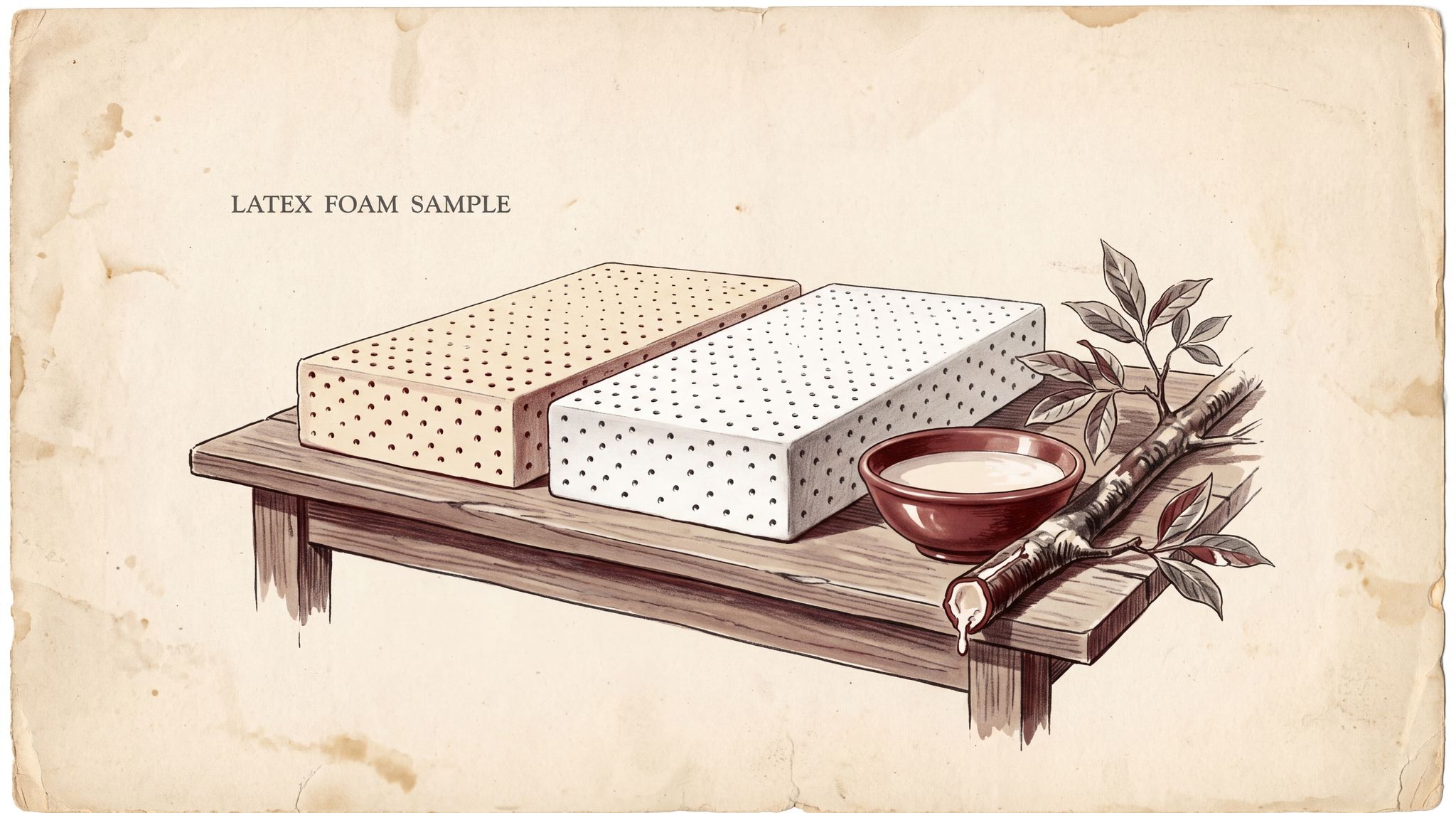
Natural latex is the milky sap of the rubber tree, whipped into foam and cured with heat. Our guide to natural latex covers how it is tapped and processed. On a pillow label, "100% natural" is a claim about the rubber. It says none of that rubber is styrene-butadiene rubber (SBR), a synthetic made from petrochemicals. It does not say that sap is the only ingredient.
Makers who publish their chemistry agree on this. One latex mattress maker says no one sells foam above 95 to 97% natural latex, and the other 3 to 5% is a curing package (Savvy Rest). A UK bed retailer says foam sold as "100% natural" is 90 to 96% natural in practice (John Ryan By Design).
Read "100% natural" as "all of the rubber is natural," not "all of the foam is rubber." That reading is fair to honest sellers. It also shows where the wording is weak. The word "natural" has no standardized legal definition in mattress labeling (Sustainable Jungle), so a page can use it without giving any number. Regulators have noticed. The Federal Trade Commission challenged one company's claim that its mattresses were made from 100 percent natural materials (FTC).
Why can no latex foam be 100% rubber tree sap?
Liquid latex only sets into a stable foam when curing agents are added and heated. Those agents stay in the pillow, at about 3 to 5% of it.
Liquid latex cannot hold a shape by itself. To become foam, it is mixed with a curing package, whipped with air, poured into a mold and heated. This step is called vulcanization. Heating the rubber with sulfur turns it from a liquid into a solid, and zinc oxide protects it from early oxidation (Savvy Rest). Those agents stay in the finished pillow.
Curing agents make up a small share of the pillow. One review of latex marketing puts the curing agents in foam sold as "100% natural" at about 5% (Sustainable Jungle). The organic standard builds a similar limit into its rules: at least 95% of the material must be certified organic raw material by weight, and filler content is limited too (Sustainable Jungle).
Talalay foam adds one more complication. One seller that publishes figures says natural Talalay contains 2 to 3% synthetic rubber, which acts as a bonding agent (Mayers Bedding).
So by one seller's account, a "100% natural" Talalay pillow may contain a trace of synthetic rubber. The amount is tiny compared with a blend, so this is not a scandal. It does show that "100%" works as a trade convention, not a lab result. You should treat it as the name of a category, like "whole grain," rather than a measured purity.
What is blended latex, and what ratio is typical?
Blended latex mixes natural rubber with synthetic SBR before molding. The usual split is 30% natural to 70% synthetic, though some go lower.
Blended latex is made by mixing liquid natural latex with liquid synthetic latex before the foam is molded. Blended foam is all latex, but it is not all natural. The split quoted most often is 30% natural to 70% synthetic (Mayers Bedding). That ratio goes back a long way. The original blended product from Latex International, now Talalay Global, was 30% natural rubber and 70% SBR (FloBeds).
Blends vary widely. One guide says a blend can contain anywhere from 30 to 94% natural latex, and only foam at 95% or above can be certified organic (Amerisleep). Even reference sites disagree. One site gives the typical blend as 30% natural on one page (latexmattress.org) and 70% natural on another (latexmattress.org). When published references reverse the ratio, trust only the figure the seller gives for the pillow you are buying.
| Foam as described | Natural rubber share | The rest | Source |
|---|---|---|---|
| Organic, to the organic latex standard | At least 95% certified organic raw material | Limited fillers | Sustainable Jungle |
| "100% natural," one maker's figure | 95 to 97% | 3 to 5% curing package | Savvy Rest |
| Natural Talalay, one seller's figure | Mostly natural | 2 to 3% synthetic bonding agent | Mayers Bedding |
| Blended, published range | 30 to 94% | Synthetic SBR | Amerisleep |
| Blended, typical | 30% | 70% synthetic | Mayers Bedding |
What do latex pillow listings say about their latex content?
Most of the pillow pages we read gave no percentage at all. Only 3 of 9 stated a figure, and none of them disclosed a synthetic share.
Our count: on September 27, 2026, we read the product text of 9 latex pillow pages sold in the United States. We found them by searching for natural, Dunlop, Talalay, blended and organic shredded latex pillows. We sorted each page by what it said about the latex and ignored everything else. 3 gave a percentage, 3 named a certification but gave no percentage, and 3 gave neither.
Four pages named Talalay, and 3 of those 4 gave neither a figure nor a certification. Some pages put details in tabs or photos that we did not see. So read the third group as "not stated in the text," not "not stated anywhere."
An outside reviewer reported that one of those pillows, labeled natural, had a core of 70% synthetic and 30% natural latex when it was reviewed (Mattress Clarity). You would not learn that from the seller's own page.
| Page | Content wording | Group |
|---|---|---|
| Dunlop pillow (Talatex on Amazon) | 100% natural | Percentage |
| Naturally Organic shredded (The Clean Bedroom) | 100% organic, names the organic standard | Percentage |
| Shredded pillow (Soaring Heart) | Over 95% organic | Percentage |
| Shredded pillow (Organic Textiles) | Names the organic standard | Certification |
| Shredded pillow (PlushBeds) | Names the organic standard | Certification |
| Talalay pillow (Avocado) | FSC latex | Certification |
| Talalay pillow (Brooklyn Bedding) | Rubber tree sap | Neither |
| Talalay pillow (Bear) | Natural | Neither |
| Talalay pillow (Latex Mattress Factory) | None | Neither |
Does a GOLS or OEKO-TEX label tell you the percentage?
GOLS requires at least 95% certified organic raw material in the latex. OEKO-TEX tests for harmful substances, not latex content.
GOLS is the only mark in this field that is built around content. GOLS requires latex to hold at least 95% certified organic raw material by total weight before it can carry the label, and the standard also limits filler content (Sustainable Jungle). The rubber must come from plantations certified organic under USDA or EU rules. A transaction certificate goes with every sale along the supply chain (Control Union).
OEKO-TEX STANDARD 100 answers a different question. It tests textiles against more than 1,000 harmful substances (OEKO-TEX), and the limits are stricter for products in direct contact with skin, such as bed linens (OEKO-TEX). Nothing in that test tells you how much of the rubber came from a tree. A forest-sourcing mark, like the FSC claim on one page in our count, is about where the latex came from, not how much of the foam it makes up.
| Mark on the page | Checks natural share? | What it checks |
|---|---|---|
| GOLS | Yes, at least 95% | Organic origin, fillers, harmful substances, emissions |
| OEKO-TEX STANDARD 100 | No | Harmful substances in textiles |
| FSC | No | Where the latex was sourced |
| "Natural" with no mark | No | Nothing independent |
Does "Talalay" on a label mean blended latex?
Not by itself. Talalay is a way of making foam, and it can be done with natural or blended latex, so the process alone says nothing about the ratio.
Talalay and Dunlop are two ways of turning liquid latex into foam. In the Talalay process, the latex is whipped with air, pulled into a mold by vacuum, and flash-frozen at -22°F (-30°C). It is then heated to 220°F (104°C) to set it (Avocado). The Dunlop method has been used since 1929. The latex is poured into a mold and steam-baked, which makes a denser foam (Mayers Bedding). Our guide to Talalay, Dunlop, shredded and solid latex pillows explains how each one feels.
Blending is mostly done with Talalay, so the process name still matters. One reference site says that usually only Talalay latex is blended (latexmattress.org). Our count points the same way. Every page in it that said nothing about content was a Talalay pillow, including pages that describe their latex as natural or as rubber tree sap.
If a page says "Talalay" and gives no percentage, ask the seller about that pillow first. Going by these sources, a page that says "Dunlop" with no percentage is less likely to be a blend. You still cannot confirm that from the process name alone.
What should a pillow label say if the latex is natural?
A clear label names the process, gives the natural share as a number, names any synthetic share, and points to a content certificate you can check.
A complete description answers four questions: how the foam was made, what share is natural, whether any of it is synthetic, and whether there is a certificate you can look up. Few pages in our count managed all four, and the table below goes through the common phrases and what each one leaves open.
| Wording on the page | What it tells you | What to ask |
|---|---|---|
| "100% natural latex" | No synthetic rubber, by the seller's account | Is there a content certificate? |
| "Natural latex" with no number | Some natural rubber is present | What is the natural-to-synthetic ratio? |
| "Talalay latex" alone | How the foam was made | Is it natural Talalay or blended? |
| "Blended" or a ratio such as 30/70 | A synthetic share, and its size | Is the price in line with a blend? |
| A GOLS mark | At least 95% certified organic raw material | What is the certificate number? |
| "OEKO-TEX" only | Passed harmful-substance testing | What is the latex content? |
Check the size in inches too. Molded latex pillows often do not fit the standard 20 by 26 inch case. One "standard" Dunlop listing measures 23.5 by 16 by 5 inches (60 × 40 × 13.5 cm) (Talatex on Amazon). A seller who publishes the size, height and ratio has given you something to hold them to.
Is a blended latex pillow a bad buy?
Not always. A blend can cost less and still feel like latex. You lose out when you pay a natural price for a blend the label never admits to.
A blend is a legitimate product when it is sold as one. One reference site argues that blended latex gives most of the benefits of natural latex at a more manageable price (latexmattress.org). A reviewer who tried a blended Talalay pillow rated it 5 out of 10 for firmness and found it soft and plush. That review listed height options of 4 and 5 inches (Mattress Clarity).
Price tells you little about the foam inside. Blends and natural foam are both sold under the word "natural," so a high price alone does not prove the rubber came from trees.
A blend gives up part of its natural origin. SBR is made from petrochemicals and does not biodegrade (Sustainable Jungle). If that matters to you, the ratio matters too. You lose out only when you pay a natural price for a blend that the page never names. Our guide on whether a natural latex pillow is worth it covers the labels and sizes to check before paying for natural foam.
Common questions
Short answers to the questions people ask most about latex percentages, organic claims, shredded fill and what to ask a seller directly.
Is "all natural latex" the same as "100% natural latex"?
Not on paper. Neither phrase has a legal definition in mattress labeling (Sustainable Jungle), so both depend on the seller. A stated ratio or a content certificate turns either phrase into something you can check.
Can you tell blended from natural latex by hand?
Not reliably. We found no published method a buyer can use at home. Rely instead on the ratio the seller states and on a content certificate. GOLS is one, and it traces the latex through the supply chain.
Does organic latex contain more natural rubber than "100% natural" latex?
About the same. GOLS requires a minimum of 95% certified organic material (Sustainable Jungle), close to the 95 to 97% one maker gives for natural foam (Savvy Rest). Organic adds certified organic plantations and an audited supply chain (Control Union).
Is shredded latex more likely to be blended?
Not in our count. All 4 shredded pillow pages we read named the organic latex standard, and 2 of them also gave a percentage. Every page that stated nothing about content was a Talalay pillow.
What should I ask a seller who gives no percentage?
Ask for the natural-to-synthetic ratio, whether the foam is Talalay or Dunlop, and the certificate number if a certification is claimed. A seller of natural foam should be able to answer all three in one line.
Has the FTC acted on natural latex claims?
Yes, and its cases show why a written ratio protects you as a buyer. The FTC said the latex core of one company's mattress was synthetic, not natural, even though its ads said otherwise (FTC). It also challenged another company's claim that its mattresses were made from all natural materials (FTC). Those actions came after people had already bought the products. Asking for the ratio before you pay means you know what you are sleeping on from the first night.
Sources
Section 9 of this spec: references, numbered in the order they first appear, each tagged with its citing section.
- Sustainable Jungle (sustainablejungle.com), cited in “What does "100% natural latex" mean on a pillow label?”; “Why can no latex foam be 100% rubber tree sap?”; “What is blended latex, and what ratio is typical?”; “Does a GOLS or OEKO-TEX label tell you the percentage?”; “Is a blended latex pillow a bad buy?”; “Common questions”.
- Mayers Bedding (mayersbedding.com), cited in “Key Takeaways”; “Why can no latex foam be 100% rubber tree sap?”; “What is blended latex, and what ratio is typical?”; “Does "Talalay" on a label mean blended latex?”.
- Savvy Rest (savvyrest.com), cited in “Key Takeaways”; “What does "100% natural latex" mean on a pillow label?”; “Why can no latex foam be 100% rubber tree sap?”; “What is blended latex, and what ratio is typical?”; “Common questions”.
- Amerisleep (amerisleep.com), cited in “Key Takeaways”; “What is blended latex, and what ratio is typical?”.
- John Ryan By Design (johnryanbydesign.co.uk), cited in “What does "100% natural latex" mean on a pillow label?”.
- FTC (ftc.gov), cited in “What does "100% natural latex" mean on a pillow label?”; “Common questions”.
- FloBeds (flobeds.com), cited in “What is blended latex, and what ratio is typical?”.
- latexmattress.org (latexmattress.org), cited in “What is blended latex, and what ratio is typical?”; “Does "Talalay" on a label mean blended latex?”.
- latexmattress.org (latexmattress.org), cited in “What is blended latex, and what ratio is typical?”; “Is a blended latex pillow a bad buy?”.
- Mattress Clarity (mattressclarity.com), cited in “What do latex pillow listings say about their latex content?”; “Is a blended latex pillow a bad buy?”.
- Talatex on Amazon (amazon.com), cited in “What do latex pillow listings say about their latex content?”; “What should a pillow label say if the latex is natural?”.
- The Clean Bedroom (thecleanbedroom.com), cited in “What do latex pillow listings say about their latex content?”.
- Soaring Heart (soaringheart.com), cited in “What do latex pillow listings say about their latex content?”.
- Avocado (avocadogreenmattress.com), cited in “What do latex pillow listings say about their latex content?”; “Does "Talalay" on a label mean blended latex?”.
- Brooklyn Bedding (brooklynbedding.com), cited in “What do latex pillow listings say about their latex content?”.
- Bear (bearmattress.com), cited in “What do latex pillow listings say about their latex content?”.
- Latex Mattress Factory (latexmattressfactory.com), cited in “What do latex pillow listings say about their latex content?”.
- Control Union (controlunion.com), cited in “Does a GOLS or OEKO-TEX label tell you the percentage?”; “Common questions”.
- OEKO-TEX (oeko-tex.com), cited in “Does a GOLS or OEKO-TEX label tell you the percentage?”.
- OEKO-TEX (oeko-tex.com), cited in “Does a GOLS or OEKO-TEX label tell you the percentage?”.
- FTC (ftc.gov), cited in “Common questions”.