Should you buy a firm latex pillow or a soft one?
Updated .
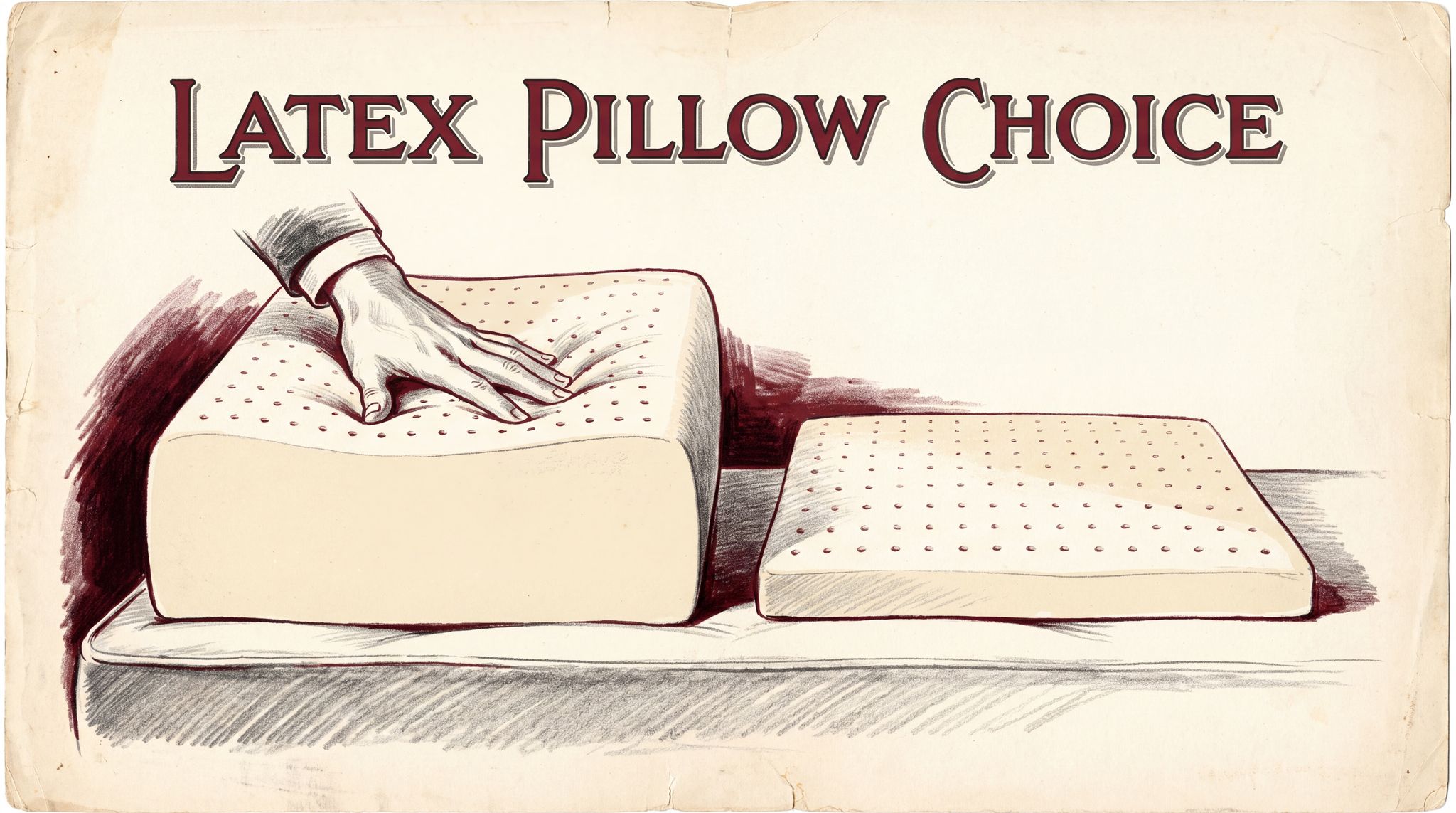
Most latex pillow listings say firm or soft, and neither word is a measurement. One seller calls a 24 ILD pillow soft. Another describes a 17 to 20 ILD pillow as its most supportive. This guide shows how to read past the label to the two numbers that decide how a pillow holds your head: its firmness rating and its height in inches.
Short answer: A firm latex pillow suits side sleepers who need more than 5 inches of height that will not collapse. A soft one suits stomach sleepers who want less than 3 inches. Back sleeping sits in between, and in every case a stated ILD or density number tells more than the adjective. Only 2 of the 10 pillow pages we read on 27 September 2026 gave an ILD, so you may have to ask for it.
This guide is for: people choosing between a firm and a soft solid latex pillow who want to compare listings by their numbers rather than their adjectives.
Key Takeaways
- Only 2 of the 10 latex pillow pages we read on 27 September 2026 stated an ILD number. Another 2 gave a density grade, and 6 gave a firmness word and nothing else.
- Labels do not carry over between sellers: Avocado sells a 24 ILD pillow as soft, while Talatex describes a 17 to 20 ILD pillow as its most supportive.
- Height moves the neck more than most people expect. In one study, going from a 110 mm to a 170 mm pillow raised the cervical angle by 66.4% (PeerJ, 2016).
On This Page
What makes a latex pillow firm or soft?
Firmness comes from latex density and the process that made it. Dunlop usually feels firmer than Talalay, and shape changes it again.
Two things set how firm a solid latex pillow feels: how dense the foam is and how it was made. Dunlop latex is whipped, poured and baked in a mold, and that process gives the pillows a dense, supportive feel. Compared to Talalay latex, Dunlop is firmer, according to Turmerry's product page. Latex Mattress Factory describes Talalay as lighter, softer and more breathable, and Dunlop as denser and firmer.
Shape matters too, because a solid molded core pushes back evenly across its whole surface. A shredded latex pillow works differently, since the sleeper sets its firmness by hand. The Sleep Foundation notes that adding fill gives a firmer feel and more height, while removing it gives a softer, lower surface.
So a firm latex pillow is usually a solid Dunlop core. A soft one is usually a Talalay core or a lightly filled shredded pillow. That is a tendency, not a rule. Our guide on Talalay, Dunlop, shredded or solid latex compares the four types, and the page on what natural latex is explains the raw material. The rest of this page deals with solid cores, where the factory fixes the firmness and you cannot change it after you buy.
What does an ILD number tell you about a pillow?
An ILD number is the force in pounds needed to press a test block of foam down by a quarter. It describes the latex, not the pillow shape.
ILD stands for indentation load deflection. Latex Mattress Factory explains that ILD measures how much force is needed to compress a layer by 25% of its thickness, and a higher number means firmer latex. The test comes from ASTM D3574, a foam standard that TestResources lists as applying to mattresses, bedding and pillows, among other products.
The number describes a test block rather than a pillow. Test fixture maker Universal Grip gives 15 by 15 by 4 inch blocks as an example specimen for IFD tests (ILD by its other name). TestResources describes the core step: a four inch thick sample is pressed down until it is three inches thick, and the load needed is measured in pounds. A pillow is not a 4 inch slab. It is molded, often shaped, and full of pinholes. ZwickRoell notes that one part of the standard says the finished molded product should be tested if possible, which tells you block results and product results can differ.
That is why careful sellers word it the way Avocado does. Avocado describes its medium pillow as made from 28 ILD latex and its soft option from 24 ILD latex. The number rates the material. It still helps, because pillows cut from 24 and 28 ILD latex will rank in that order. Use ILD to compare firmness, and use height in inches to predict where your head will sit.
Do sellers' firm and soft labels mean the same thing?
No. Firmness words are not standardized, so one seller's soft pillow can be firmer by the numbers than another seller's most supportive one.
A retailer's guide from Mattress Miracle says pillow firmness terms are not standardised across manufacturers, and one brand's medium firm may feel soft next to another's. The published numbers show how far the labels drift.
| Product (seller page) | Seller's label | Number the page states | Our reading |
|---|---|---|---|
| Latex Mattress Factory Dunlop layers | Soft, medium, firm, extra firm | 19, 28, 38, 44 ILD | Layer grades, a handy reference scale |
| Avocado Pure Talalay pillow | Soft, medium | 24, 28 ILD | Its soft sits above the layer seller's soft |
| Talatex Premium pillow | Most support | 17 to 20 ILD | Low ILD; relies on height |
| Avocado Molded pillow | Firmer pillow | D55 density | Density grade, not ILD |
| Turmerry contour pillow | Medium, firm | 45K, 55K density | Names shift on a wholesale listing |
One word covers very different latex: Avocado's soft pillow is 24 ILD, while Talatex rates its pillow at 17 to 20 ILD and says it is designed to provide the most support, for side sleepers with broad shoulders. By the numbers, the soft pillow is the firmer latex. Talatex uses metric sizes, and its 15 cm height converts to 5.9 inches.
Turmerry shows the drift inside one product. Its own contour page grades medium at 45K and firm at 55K, while a wholesale listing for the pillow calls 45K soft, 55K medium and 65K firm. Compare numbers only against numbers on one scale.
What did we find when we counted seller pages?
Of 10 latex pillow pages read on 27 September 2026, 2 stated an ILD, 2 stated only a density grade, and 6 gave a firmness word alone.
We read 10 seller product pages for latex bed pillows on 27 September 2026 and counted what each one states about firmness. We picked pages selling a solid or Talalay latex pillow to US buyers and left out toppers, travel, toddler and body pillows. This count records only what the pages say, and it involved no pressing, weighing or sleeping on any pillow.
The pages fell into three buckets:
- Stated an ILD (2 of 10): Avocado Pure Talalay pillow and Talatex Premium pillow.
- Stated a density grade, no ILD (2 of 10): Avocado Molded pillow and Turmerry contour pillow.
- Gave a firmness word only (6 of 10): Turmerry latex pillow, Latex Mattress Factory Talalay pillow, My Organic Sleep Talalay pillow, Custom Sleep Technology Talalay pillows, Comfort Sleep Systems Talalay pillow, and the Naturepedic solid pillow as listed by The Clean Bedroom.
Only 1 page in 5 gave the number that firmness guides point readers toward. The word-only pages were not vague about everything. Latex Mattress Factory gives its high profile pillow as 6 inches tall with a Medium-Plush feel, and its low profile as 4.5 inches with a Super Soft feel. Those labels are the only firmness guide on offer.
When a page gives only a word, the seller can be asked for the ILD. Height in inches is the next best figure, because you can check it against your own position.
Which firmness suits the way you sleep?
Side sleeping usually needs a firm, tall pillow, stomach sleeping a soft, thin one, and back sleeping something medium in both firmness and height.
Seller guides agree on the broad pattern, even where their labels differ. Custom Sleep Technology suggests its soft pillows for stomach and back sleepers and its medium and firm pillows for back and side sleepers. Turmerry pairs side sleeping with a firm, high pillow, back sleeping with a medium, mid-height one, and stomach sleeping with a soft, mid-height one. The gap under the head drives that split: side lying leaves the widest space, and a pillow that collapses lets the neck bend down.
| How you sleep | Firmness | Height | ILD one seller guide suggests | Our judgement |
|---|---|---|---|---|
| On your side | Firm | Over 5 in | 30 to 40 | Height first; firm keeps it under load |
| On your back | Medium | 3 to 5 in | 24 to 32 | Too tall pushes the chin forward |
| On your stomach | Soft | Under 3 in | 14 to 22 | Keep it low above all |
| Changing positions | Medium | 3 to 5 in | 24 to 30 | Adjustable shredded fill is worth a look |
The ILD ranges come from one seller's guide, not from research. Read them as a starting point. The height bands follow Sleep Doctor, which calls pillows under 3 inches low, 3 to 5 inches medium, and over 5 inches high. Body size shifts the answer. Sleep Doctor's testing found that side sleepers over 230 pounds felt most supported on a solid Dunlop model.
Does pillow height matter more than firmness?
Height sets the angle of your neck, and firmness decides how much of that height is left once your head is on the pillow. Choose both together.
Height sets the neck angle, so it deserves at least as much attention as the label. In a 2016 study, 10 healthy subjects lay on pillows 110, 130, 150 and 170 mm tall. Going from the lowest to the highest caused a 66.4% increase in cervical angle, and average pressure under the skull was about 30% higher on the tallest pillow.
In inches, those four heights run from about 4.3 to 6.7, which is our conversion rather than a figure the study gives.
The evidence has limits. A 2021 review of pillow height research found no firm conclusions yet about the best height for back or side lying. Research backs the idea that height changes the angle of the neck, but it does not name one number for everyone.
Firmness and height work as a pair. Under one head's weight, firmer latex compresses less, so two pillows with matching listed heights can hold a head at different heights. The mattress changes the sum too. A softer one lets the shoulder sink further and narrows the gap the pillow must fill, as Sleep365 points out. For support under the neck that is separate from the head, our guide to latex contour pillows covers that shape.
Will a solid latex pillow fit a standard 20 by 26 inch case?
It fits, but loosely. The solid cores listed here run about 16 inches wide, so a 20 by 26 inch case leaves roughly 4 inches of slack across.
A standard American pillow measures 20 by 26 inches, according to Boll & Branch, and standard cases are sold to fit it. Solid latex cores are usually narrower. Every molded pillow below is about 16 inches across. Avocado lists its soft standard/queen core at 27.5 by 16 by 4.5 inches and 2.9 pounds, and its medium at 5.75 inches and 3.3 pounds.
| Pillow, standard size | Stated size (in) | Height (in) | Length against 26 in |
|---|---|---|---|
| Avocado Pure Talalay | 27.5 x 16 | 4.5 or 5.75 | 1.5 in longer |
| Latex Mattress Factory Talalay | 25 x 16 | 4.5 or 6 | 1 in shorter |
| Naturepedic solid | 24 x 16 | Not stated there | 2 in shorter |
| Talatex Premium | 23.6 x 15.7 (60 x 40 cm) | 5.9 (15 cm) | 2.4 in shorter |
The length column is our arithmetic from the sellers' stated sizes, and no seller publishes it. Across the width, the same arithmetic gives about 4 inches of slack for the 16 inch cores and 4.3 inches for the Talatex core. In practice the core sits loose across its width and can slide inside the case. When the core came with its own fitted cover, the case is only an outer layer, and some slack does little harm. The Avocado core runs longer than a standard case, so check length as well as width before you order.
How can you check firmness before you buy?
Look for a stated ILD first, then a height in inches, then a risk-free trial long enough to sleep on the pillow before committing.
Read the listing in a fixed order, starting with the most precise figure. First, look for an ILD number, and note whether it describes the latex or the finished pillow. Second, look for a density grade such as D55 or 55K. None of the 10 pages we read converted a grade into ILD. Third, find the height in inches and compare it with the band for your position in the table above. Listings often call height "loft", and the two words name one measurement.
Then check the terms. Naturepedic offers a risk-free trial on its solid pillow and notes that the pillow is spot clean only. A trial matters more for a solid core, because a solid pillow's firmness cannot be adjusted once it arrives.
One more check applies to some buyers. An Amazon listing for a Talalay pillow warns that people allergic to protein may find a natural latex pillow does not suit them, so settle that question first if it applies. When torn between two firmness levels, pick the one whose height matches the way you sleep.
Common questions
Short answers on neck pain, Dunlop versus Talalay, weight, density grades and whether a soft pillow can work for side sleepers.
Is a firm latex pillow good for neck pain?
It can help if it holds your head level. A 2021 review found no firm conclusions on the best height for back or side lying. Anyone who wakes stiff should check height first.
Is Talalay latex softer than Dunlop?
Usually, yes. Sellers such as Latex Mattress Factory describe Talalay as softer. Talalay can still be made firm, since Custom Sleep Technology sells solid Talalay pillows in medium and firm densities. Check the number, not the process name.
Can a soft latex pillow work if you sleep on your side?
It can if it is tall enough. Talatex rates its pillow at 17 to 20 ILD and sells it for people with broad shoulders, at 5.9 inches (15 cm) tall. Soft and thin together is the pairing to avoid.
How much does a solid latex pillow weigh?
Enough to keep its shape: about 3 pounds for a standard size. Avocado lists 2.9 and 3.3 pounds, and a Turmerry listing gives 3.3 pounds for its standard pillow. The weight comes from one solid block of foam rather than loose fill, so a person who turns over at night finds the pillow at full height each time.
Does a latex pillow get softer as it warms up?
Not the way memory foam does. Mattress Miracle says memory foam softens with body heat, while latex support does not change through the night as the foam warms.
What do "D55" or "55K" mean on a listing?
They are density grades, not ILD numbers. Avocado says its molded pillow's latex has a soft density (D55), yet sells it as a firmer pillow. Compare grades only within one seller's range.
Sources
Section 9 of this spec: references, numbered in the order they first appear, each tagged with its citing section.
- Avocado (avocadogreenmattress.com), cited in “Key Takeaways”; “What does an ILD number tell you about a pillow?”; “Do sellers' firm and soft labels mean the same thing?”; “What did we find when we counted seller pages?”; “Will a solid latex pillow fit a standard 20 by 26 inch case?”.
- Talatex (talatex.com), cited in “Key Takeaways”; “Do sellers' firm and soft labels mean the same thing?”; “What did we find when we counted seller pages?”; “Will a solid latex pillow fit a standard 20 by 26 inch case?”.
- PeerJ, 2016 (pmc.ncbi.nlm.nih.gov), cited in “Key Takeaways”; “Does pillow height matter more than firmness?”.
- Turmerry's product page (turmerry.com), cited in “What makes a latex pillow firm or soft?”; “What did we find when we counted seller pages?”; “Which firmness suits the way you sleep?”.
- Latex Mattress Factory (latexmattressfactory.com), cited in “What makes a latex pillow firm or soft?”; “Common questions”.
- Sleep Foundation (sleepfoundation.org), cited in “What makes a latex pillow firm or soft?”.
- Latex Mattress Factory (latexmattressfactory.com), cited in “What does an ILD number tell you about a pillow?”.
- TestResources (testresources.net), cited in “What does an ILD number tell you about a pillow?”.
- Universal Grip (universalgripco.com), cited in “What does an ILD number tell you about a pillow?”.
- TestResources (testresources.net), cited in “What does an ILD number tell you about a pillow?”.
- ZwickRoell (zwickroell.com), cited in “What does an ILD number tell you about a pillow?”.
- Mattress Miracle (mattressmiracle.ca), cited in “Do sellers' firm and soft labels mean the same thing?”; “Common questions”.
- Latex Mattress Factory Dunlop layers (latexmattressfactory.com), cited in “Do sellers' firm and soft labels mean the same thing?”.
- Avocado Molded pillow (avocadogreenmattress.com), cited in “Do sellers' firm and soft labels mean the same thing?”; “What did we find when we counted seller pages?”; “Common questions”.
- Turmerry contour pillow (turmerry.com), cited in “Do sellers' firm and soft labels mean the same thing?”; “What did we find when we counted seller pages?”.
- wholesale listing (usawholesalesupplier.com), cited in “Do sellers' firm and soft labels mean the same thing?”.
- Latex Mattress Factory Talalay pillow (latexmattressfactory.com), cited in “What did we find when we counted seller pages?”; “Will a solid latex pillow fit a standard 20 by 26 inch case?”.
- My Organic Sleep Talalay pillow (myorganicsleep.com), cited in “What did we find when we counted seller pages?”.
- Custom Sleep Technology Talalay pillows (customsleeptech.com), cited in “What did we find when we counted seller pages?”; “Which firmness suits the way you sleep?”; “Common questions”.
- Comfort Sleep Systems Talalay pillow (comfortsleepsystems.myshopify.com), cited in “What did we find when we counted seller pages?”.
- Naturepedic solid pillow as listed by The Clean Bedroom (thecleanbedroom.com), cited in “What did we find when we counted seller pages?”.
- one seller's guide (sleep365.com), cited in “Which firmness suits the way you sleep?”; “Does pillow height matter more than firmness?”.
- Sleep Doctor (sleepdoctor.com), cited in “Which firmness suits the way you sleep?”.
- 2021 review of pillow height research (pmc.ncbi.nlm.nih.gov), cited in “Does pillow height matter more than firmness?”; “Common questions”.
- Boll & Branch (bollandbranch.com), cited in “Will a solid latex pillow fit a standard 20 by 26 inch case?”.
- Naturepedic solid (theorganicbedroom.com), cited in “Will a solid latex pillow fit a standard 20 by 26 inch case?”.
- Naturepedic (naturepedic.com), cited in “How can you check firmness before you buy?”.
- Amazon listing for a Talalay pillow (amazon.com), cited in “How can you check firmness before you buy?”.
- Turmerry listing (usawholesalesupplier.com), cited in “Common questions”.