Should you buy a Talalay, Dunlop, shredded or solid latex pillow?
Updated .
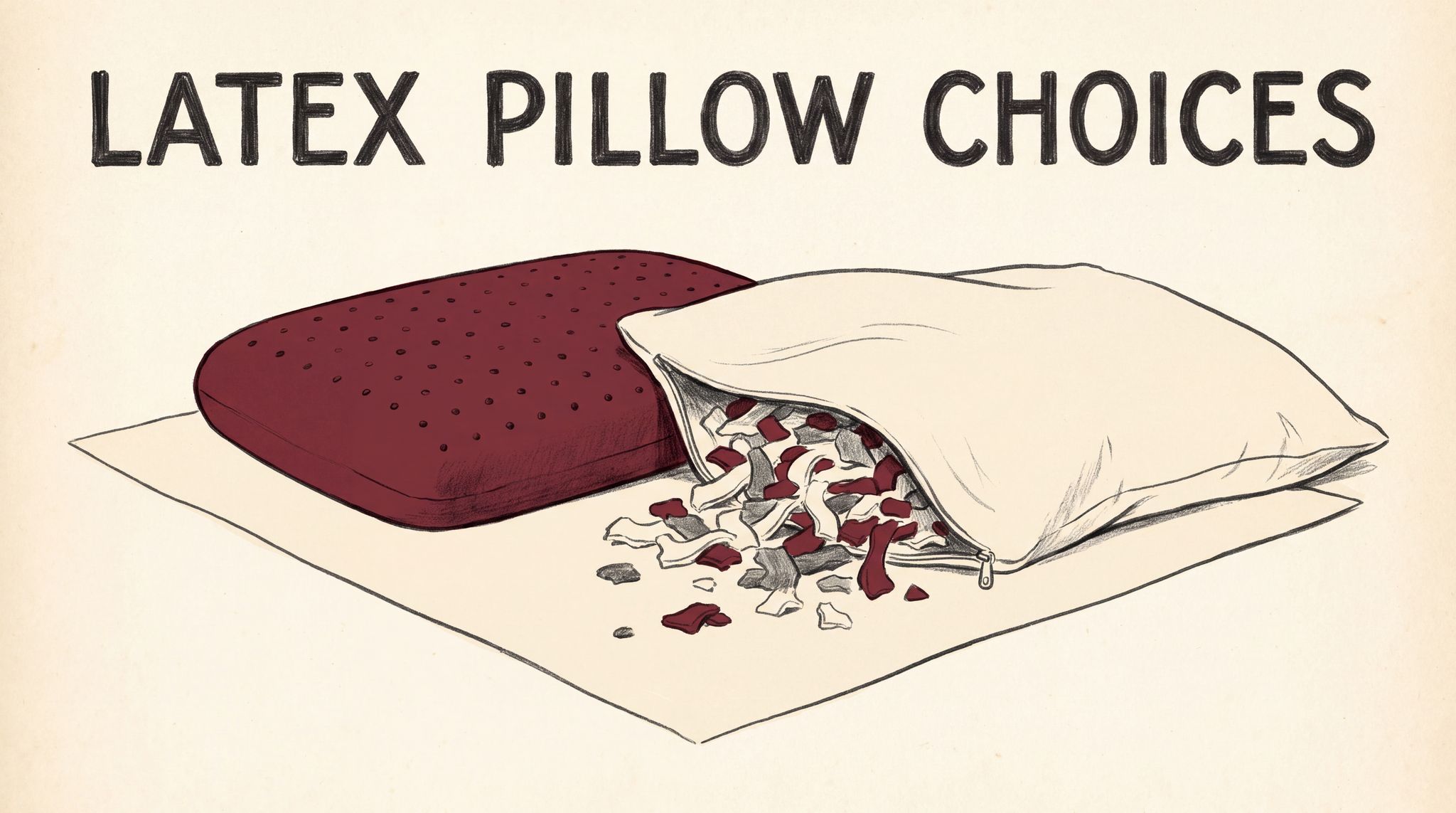
A latex pillow is foam made from rubber tree sap. Every one on sale combines two choices: the process that made the foam, and whether it comes as one block or many small pieces. The research is thin, but it exists. In a 2009 trial, 106 people who preferred to sleep on their side with one pillow each tried several pillows for a week at a time (Gordon et al., Manual Therapy, 2009). The rubber pillow performed better than people's own pillow in most instances (Flinders University record). This page covers the four types, the heights sellers list, and how heavy the pillow will be when it arrives.
Short answer: Pick the form first and the process second. A solid pillow has one fixed height, often about 5 inches, and suits people who want the same support every night, while a shredded pillow lets the owner take fill out until the height feels right. Dunlop foam is denser, and Talalay is lighter and more even. In a 2009 trial of 106 side sleepers, the latex pillow beat people's own pillows in most instances. Anyone with a latex allergy should skip latex entirely.
This guide is for: people in the United States buying their first latex pillow, or replacing one, who want to read a product page and know what it does and does not tell them.
Key Takeaways
Three points carry most of the decision, and each one rests on a published figure you can check through the links in the sections below.
- Height matters before material does. A 2021 review found that neck alignment depends on the pillow's shape and height. The solid pillows we read list fixed heights between 4.7 inches (Talatex) and 5 inches (Avocado).
- Expect a heavy pillow. Sellers list 3.1 pounds for one solid standard pillow (Avocado). Shredded or mixed-fill ones run from 3.4 pounds (LeafScore) to 6 pounds (The Natural Sleep Store). A latex pillow will not feel like the polyester one it replaces.
- Allergy is the one hard stop. Published estimates put latex allergy at about 1% (ADA) to 4.3% (Wu et al., 2016) of the general population. Anyone already diagnosed should not sleep on natural latex.
Everything else, from Talalay versus Dunlop to organic labels, comes down to feel and price rather than safety. Those are the choices where your own preference should decide.
Latex pillows at a glance
Specification as declared by 8 latex pillow makers on their own pages, read October 7, 2026.
| Latex pillow | Certificate no. | Trial | Warranty | Met |
|---|---|---|---|---|
| Avocado Molded Organic Latex Pillow | CU863637 (GOTS licence for the cotton cover; the latex core carries no organic certificate, per their page) | 100 nights | 1-year limited warranty | 3 / 3 |
| Brooklyn Bedding Talalay Latex Pillow | Not declared | 30-day returns; silent on use | 3-year warranty | 1 / 3 |
| Latex Mattress Factory Talalay Latex Pillow | Not declared | 30-day returns, $45 fee; silent on use | Not declared | 0 / 3 |
| PlushBeds Solid Natural Latex Pillow | CU1007386 (maker) | Not returnable | 3-year warranty | 2 / 3 |
| Sleep On Latex Natural Latex Pillow | OEKO-TEX 17.HUS.25845; GOTS-10236 | 30 days, free return label | 5-year warranty | 3 / 3 |
| Soaring Heart Ergonomic Latex Pillow | GOTS workshop named, no number | Returns unused only, 30 days | Not declared | 0 / 3 |
| Talatex Premium Latex Pillow | Not declared | 30-day trial (exchange) | 1-year limited warranty | 2 / 3 |
| Turmerry Shredded Latex Pillow | Not declared | Returns unused only, 120 days | 1-year limited warranty | 1 / 3 |
Editor's picks
Criterion: of 8 latex pillow makers read, a pillow is listed when its maker declares the highest number of the 3 items specified below, and no fewer than 2. Equal counts are all listed, sorted A to Z, with no rank.
- A certificate number declared.
- A trial period declared for pillows.
- A pillow warranty in years.
- Avocado Molded Organic Latex Pillow: 3 of 3, CU863637 (GOTS licence for the cotton cover; the latex core carries no organic certificate, per their page); 100 nights; 1-year limited warranty.
- Sleep On Latex Natural Latex Pillow: 3 of 3, OEKO-TEX 17.HUS.25845; GOTS-10236; 30 days, free return label; 5-year warranty.
A listing reflects declared information. Each pillow was bought and handled, but no core was compressed or measured in preparing this spec.
On This Page
The eight questions below follow the order most buyers take, from what the foam is to how to care for it and when to replace it.
What is a latex pillow made of?
A latex pillow is foam made from the sap of the rubber tree, sold either as one molded block or as a cover filled with small shredded pieces.
The terms "Talalay" and "Dunlop" name two manufacturing processes. The Sleep Foundation notes that the starting material is the same, so the major difference is the process (Sleep Foundation, 2025). What reaches the buyer is foam, either a single molded block or loose shreds inside a zippered cover. Our page on what natural latex is explains how sap becomes rubber.
The word on the label matters more than the process. Natural, blended and synthetic latex can all be sold as a "latex pillow." NapLab notes that some makers of Dunlop foam use synthetic materials or a blend of natural and synthetic compounds. It adds that Talalay can be natural, synthetic or a mix of the two, but it cannot be organic (NapLab, 2026). A page that says only "latex" has not said which kind is inside.
An organic claim has a meaning a buyer can check. When the certifier Control Union announced its organic latex standard, it said the standard covers foam with a 95% latex rubber sap content. That sap must come from certified organic rubber plantations (Control Union via PR Newswire, 2017). An organic certificate describes the latex, not the comfort. If a page claims organic latex but names no certificate, ask the seller for it before ordering.
What is the difference between Talalay and Dunlop latex?
Both start as the same rubber sap. Dunlop is poured and baked, while Talalay adds a vacuum and a freeze, which makes a lighter, more even foam.
Dunlop, the older method, was first developed in 1929 and has changed little since, according to the Sleep Foundation (Sleep Foundation, 2025). In it, the latex is whipped into foam, poured into a mold and baked. The Talalay process came in the 1940s. It fills the mold only part way and vacuum-seals it so the latex expands. Then it freezes the foam rapidly while carbon dioxide is pushed through (Sleep Foundation, 2025). The same page says the Dunlop mix is not evenly distributed, so a Dunlop block can be firmer at the bottom than at the top.
The real difference is density, not a fixed firmness. One retailer whose mattresses and toppers are all Dunlop says both kinds of foam can be produced in a wide variety of firmnesses (SleepOnLatex). Treat that as a seller's view. Talalay costs more to produce than Dunlop, so it tends to carry a higher price (NapLab, 2026).
| Dunlop | Talalay | |
|---|---|---|
| How it is made | Whipped, poured, baked (Sleep Foundation) | Part-filled, vacuum-sealed, frozen (Sleep Foundation) |
| Introduced | 1929 (Sleep Foundation) | Late 1940s (NapLab) |
| Density | Higher, can be firmer at the bottom | Lower, more uniform |
| Organic version | Possible | Not possible, per NapLab |
| Relative cost | Lower | Higher |
Should you choose a shredded or solid latex pillow?
Choose solid if you want one fixed shape that never needs fluffing. Choose shredded if you are unsure what height you need and want to adjust it.
A solid pillow is a single molded piece. Avocado lists its molded latex pillow at 5 inches high in the standard size (Avocado). What arrives is what gets slept on. That suits people who already know the height they like. The block cannot be adjusted, so a pillow that is too high on the first night stays too high.
A shredded pillow is a zippered cover filled with small pieces of latex. Latex Mattress Factory's shredded page says you control how thick the pillow is. You remove as much or as little fill as needed (Latex Mattress Factory, shredded). Some shredded pillows mix in another fiber. One reviewer reports a fill of 70 percent natural latex rubber shreds and 30 percent natural kapok fibers (Sleep Advisor, 2026). Check the fill list before assuming a shredded pillow is all latex.
Our judgement: if you are unsure, buy shredded. Height can always come out of a shredded pillow, but a solid block cannot be changed. Shredded pieces shift during the night, though, so people who want a fixed curve under the neck may prefer solid. The Compared page sets more of these choices side by side.
What height of latex pillow do you need for your sleep position?
Side sleepers usually need the most height, back sleepers less, and stomach sleepers the least. The height under your head is lower than listed.

Sellers often call this "loft", but this page says height. The number on a product page is the height before a head presses it down. Talatex lists its standard Dunlop pillow at an unused height of 12 cm and a using height of 10.5 cm (Talatex). That means 4.7 inches (12 cm) settling by roughly half an inch once a head rests on it.
Body size is a weak guide. A 2021 review notes that the best pillow height does not necessarily track a person's body dimensions. That includes the length or width of the head and shoulder region (Clinical Biomechanics, 2021). The same review found that the shape and height of the pillow can significantly affect neck alignment. So start with sleep position. On your side, the pillow has to fill the gap between shoulder and ear, which takes the most height. Back sleepers need less, and stomach sleepers least of all.
With a shredded pillow, give each change a few nights before judging it. Remove fill a handful at a time and keep it in a bag. With a solid pillow, compare its listed height with the pillow you use now, laid flat on a table.
Does a latex pillow help with neck pain?
Trials favor latex over feather pillows for waking neck pain, but the effect on sleep quality is unclear and height may matter more than material.
The best-known trial is small. It used a random allocation, single blind design. Its 106 side sleepers slept for a week each on their usual pillow and on polyester, foam, feather and rubber pillows. They recorded sleep quality, pillow comfort and waking neck pain (Gordon et al., 2009). "Rubber" here means latex. The university record adds that people's own pillows performed similarly to foam and polyester. It also says a foam contour pillow showed no advantage over regular shapes, and that feather pillows should not be recommended (Flinders University record).
A 2021 meta-analysis partly agreed. It found spring and rubber pillows effective in reducing neck pain, waking symptoms and disability in patients with chronic neck pain. The effect on sleep quality was generally inconclusive (Clinical Biomechanics, 2021). A separate trial split 42 patients with cervical spondylosis into two groups at random. Both groups received 12 sessions of physical therapy over 4 weeks. The group given ergonomic latex pillows showed pain relief, less disability and more range of motion (Fazli et al., 2019).
Read these trials as a reason to try latex, not as a treatment. They are small, and a pillow at the wrong height can cancel out any benefit from the material. If your neck pain is new or severe, or comes with numbness, see a clinician before buying anything.
What do latex pillow product pages tell you?
Every solid pillow page we read named its foam process. Only one of the shredded pillow pages did, and it named a mix rather than one process.
Our count: We read 12 US seller product pages for latex bed pillows on September 26, 2026: 6 for solid pillows and 6 for shredded ones. For each, the question was whether the product text named the foam process. The pages fell into three buckets:
- Named one process: 6 pages, all solid pillows (5 Dunlop, 1 Talalay).
- Named a mix of Dunlop and Talalay: 1 page, a shredded pillow.
- Named no process: 5 pages, all shredded pillows.
| Product page | Form | Process named |
|---|---|---|
| Avocado Molded Organic Latex | Solid | Dunlop |
| Sleeping Organic Dunlop | Solid | Dunlop |
| Latex Mattress Factory Dunlop | Solid | Dunlop |
| SleepEZ Dunlop | Solid | Dunlop |
| Talatex Original | Solid | Dunlop |
| Talatex Talalay, Walmart listing | Solid | Talalay |
| Avocado Green Pillow | Shredded | None |
| Sleeping Organic shredded | Shredded | None |
| Latex Mattress Factory shredded | Shredded | Mix of Dunlop and Talalay |
| Turmerry shredded | Shredded | None |
| Suite Sleep shredded, Natural Sleep Store listing | Shredded | None |
| DIY Natural Home kit | Shredded | None |
This counts what the pages say, not what the pillows contain. The method page sets out which pages this site reads and why. If you want Talalay or Dunlop shreds specifically, ask the seller before ordering.
How heavy is a latex pillow, and will it fit a standard case?
A latex pillow's weight keeps it still. Latex is dense, so most weigh 3 to 6 pounds, and you get a pillow that stays under your head all night.
Turmerry says its shredded pillows are heavier than traditional pillows because natural latex is a dense material (Turmerry). Avocado lists 3.1 pounds for its solid standard pillow, the lightest listing we read (Avocado). The heaviest was 6 pounds, for a Suite Sleep shredded pillow (The Natural Sleep Store). You get a pillow that stays put, but it takes two hands to plump up and adds weight to a travel bag.
| Pillow, standard size | Form | Listed size (in) | Listed weight | Fits a 20 x 26 case? (our judgement) |
|---|---|---|---|---|
| Avocado Molded | Solid | 25 x 16.5 x 5 | 3.1 lb | Loose |
| Talatex Original | Solid | 23.6 x 15.7 x 4.7 | Not listed | Loose |
| Avocado Green, per LeafScore | Shredded, kapok mix | 19 x 24 | 3.4 lb | Close |
| Turmerry | Shredded | 15 x 22 x 5 | 4 lb | Loose |
| DIY Natural Home | Shredded | 20 x 26 | 4.5 lb fill | Yes |
| Suite Sleep, Natural Sleep Store | Shredded | 20 x 26 | 6 lb | Yes |
A solid latex pillow sold as "standard" is often smaller than a 20 by 26 inch American case. The case hangs loose around it, which does no harm. A zippered case cut to the pillow's own size keeps it from sliding inside. One Suite Sleep shredded pillow lists at $139 (The Natural Sleep Store), so compare a few sellers before ordering.
Is a latex pillow safe if you have a latex allergy?
If you know you are allergic to latex, do not buy one. Published estimates put latex allergy at roughly 1% to 4.3% of the general population.
Estimates depend on how the population was studied. A 2016 review reports an average worldwide prevalence of 9.7% among healthcare workers, 7.2% among susceptible patients and 4.3% in the general population (Wu et al., 2016).
Other sources give lower figures. The American Dental Association puts latex allergy at approximately 1 percent of the general population and 8 to 12 percent of healthcare workers (ADA). It explains that natural rubber latex contains proteins that can cause allergic reactions in some people.
Anyone with a diagnosed latex allergy should not sleep on a natural latex pillow, whatever the cover. A cover sits between face and foam, but adjusting a shredded pillow means putting bare hands straight into the latex.
Watch the word "hypoallergenic." On seller pages the word usually concerns dust mites and mold, not latex protein. The Latex Mattress Factory Dunlop page, for example, calls the pillow ideal for allergy sufferers. The allergens it names are dust mites, mold and bacteria (Latex Mattress Factory). A claim about mites says nothing about latex allergy. If you are unsure whether you react to latex, ask an allergist before you buy rather than find out by sleeping on one.
Common questions
Short answers to the questions buyers often raise after the first week, from washing and lifespan to how much shredded fill to take out.
How long does a latex pillow last?
Seller claims vary widely. Saatva recommends replacing its pillow every 36 months (Mattress Clarity, 2026). One kit seller says its shredded fill has the same 20 year lifespan as its latex slabs (DIY Natural Home). Replace a pillow when it stops holding the height it was set to.
Can you wash a latex pillow?
Usually only the cover. Saatva asks that the Talalay latex core be removed before washing (Mattress Clarity, 2026). One kit seller warns that sun and machine washing shorten the life of shredded latex (DIY Natural Home). Our care page covers the rest.
Is Talalay always softer than Dunlop?
No. The two differ in density, and each maker sets its own firmness. Check the firmness listed for the pillow in question, whichever foam it uses.
Can a latex pillow be organic?
Yes, if the latex carries a third-party organic certificate. Because NapLab says Talalay cannot be organic, an organic latex pillow will be Dunlop. Ask for the certificate before you pay.
Does a latex pillow sleep cooler than memory foam?
Reviewers think so. NapLab says Dunlop may feel warmer because of its high density but is still typically cooler than memory foam (NapLab, 2026). None of the trials we found tested this directly.
How much fill should you remove from a shredded pillow?
Remove a handful at a time. Wait a few nights before making big changes, and keep the fill that comes out in a bag so it can go back in.
Sources
Section 9 of this spec: references, numbered in the order they first appear, each tagged with its citing section.
- Gordon et al., Manual Therapy, 2009 (pubmed.ncbi.nlm.nih.gov), cited in “Does a latex pillow help with neck pain?”.
- Flinders University record (researchnow.flinders.edu.au), cited in “Does a latex pillow help with neck pain?”.
- Talatex (talatex.com), cited in “Key Takeaways”; “What height of latex pillow do you need for your sleep position?”; “What do latex pillow product pages tell you?”; “How heavy is a latex pillow, and will it fit a standard case?”.
- Avocado (avocadogreenmattress.com), cited in “Key Takeaways”; “Latex pillows at a glance”; “Editor's picks”; “Should you choose a shredded or solid latex pillow?”; “What do latex pillow product pages tell you?”; “How heavy is a latex pillow, and will it fit a standard case?”.
- LeafScore (leafscore.com), cited in “Key Takeaways”; “How heavy is a latex pillow, and will it fit a standard case?”.
- The Natural Sleep Store (thenaturalsleepstore.com), cited in “Key Takeaways”; “What do latex pillow product pages tell you?”; “How heavy is a latex pillow, and will it fit a standard case?”.
- ADA (ada.org), cited in “Key Takeaways”; “Is a latex pillow safe if you have a latex allergy?”.
- Wu et al., 2016 (academic.oup.com), cited in “Key Takeaways”; “Is a latex pillow safe if you have a latex allergy?”.
- Brooklyn Bedding (brooklynbedding.com), cited in “Latex pillows at a glance”.
- Latex Mattress Factory (latexmattressfactory.com), cited in “Latex pillows at a glance”.
- 30-day returns, $45 fee; silent on use (latexmattressfactory.com), cited in “Latex pillows at a glance”.
- PlushBeds (plushbeds.com), cited in “Latex pillows at a glance”.
- CU1007386 (maker) (plushbeds.com), cited in “Latex pillows at a glance”.
- Sleep On Latex (sleeponlatex.com), cited in “Latex pillows at a glance”; “Editor's picks”.
- Soaring Heart (soaringheart.com), cited in “Latex pillows at a glance”.
- GOTS workshop named, no number (soaringheart.com), cited in “Latex pillows at a glance”.
- Returns unused only, 30 days (soaringheart.com), cited in “Latex pillows at a glance”.
- Talatex (talatex.com), cited in “Latex pillows at a glance”.
- 30-day trial (exchange) (talatex.com), cited in “Latex pillows at a glance”.
- 1-year limited warranty (talatex.com), cited in “Latex pillows at a glance”.
- Turmerry (turmerry.com), cited in “Latex pillows at a glance”; “What do latex pillow product pages tell you?”; “How heavy is a latex pillow, and will it fit a standard case?”.
- Sleep Foundation, 2025 (sleepfoundation.org), cited in “What is a latex pillow made of?”; “What is the difference between Talalay and Dunlop latex?”.
- NapLab, 2026 (naplab.com), cited in “What is a latex pillow made of?”; “What is the difference between Talalay and Dunlop latex?”; “Common questions”.
- Control Union via PR Newswire, 2017 (prnewswire.com), cited in “What is a latex pillow made of?”.
- SleepOnLatex (sleeponlatex.com), cited in “What is the difference between Talalay and Dunlop latex?”.
- Latex Mattress Factory, shredded (latexmattressfactory.com), cited in “Should you choose a shredded or solid latex pillow?”; “What do latex pillow product pages tell you?”.
- Sleep Advisor, 2026 (sleepadvisor.org), cited in “Should you choose a shredded or solid latex pillow?”.
- Clinical Biomechanics, 2021 (sciencedirect.com), cited in “What height of latex pillow do you need for your sleep position?”; “Does a latex pillow help with neck pain?”.
- Fazli et al., 2019 (ovid.com), cited in “Does a latex pillow help with neck pain?”.
- Sleeping Organic Dunlop (sleepingorganic.com), cited in “What do latex pillow product pages tell you?”.
- Latex Mattress Factory Dunlop (latexmattressfactory.com), cited in “What do latex pillow product pages tell you?”; “Is a latex pillow safe if you have a latex allergy?”.
- SleepEZ Dunlop (sleepez.com), cited in “What do latex pillow product pages tell you?”.
- Talatex Talalay, Walmart listing (walmart.com), cited in “What do latex pillow product pages tell you?”.
- Avocado Green Pillow (avocadogreenmattress.com), cited in “What do latex pillow product pages tell you?”.
- Sleeping Organic shredded (sleepingorganic.com), cited in “What do latex pillow product pages tell you?”.
- DIY Natural Home kit (diynaturalhome.com), cited in “What do latex pillow product pages tell you?”; “How heavy is a latex pillow, and will it fit a standard case?”; “Common questions”.
- Mattress Clarity, 2026 (mattressclarity.com), cited in “Common questions”.