Specification in brief
Keep the foam core dry, cool and out of direct sun. Wash the cover, protector and pillowcase, never the core itself. Treat spills by blotting with a damp cloth, pressing between towels and drying flat indoors. A new pillow's rubbery smell fades within 1 to 3 days of airing, according to one seller's listing. Latex pillows typically last 3 to 5 years, according to eachnight. Replace the pillow when the foam crumbles, cracks or smells musty after drying.
This guide is for: people who own a natural latex pillow, solid or shredded, and want it to last without guessing at the instructions.
Key Takeaways
Three points carry most of the care: keep water out of the core, keep the foam out of sun and heat, and expect the smell to fade within days.
- Keep water out of the core. We read 9 sellers' care pages on October 20, 2026. Six say to spot clean or blot only, and just 2 allow a full hand wash. One of those 2 warns that frequent washing may shorten the pillow's life (Pillow Talk).
- Keep the foam away from sun and heat. All 9 pages warn against direct sunlight or heat. A US patent on natural rubber latex film reports that a week at 70 °C (158 °F), which it equates to 64 months at room temperature, cut tear strength by about half (US Patent 4,963,623).
- Expect the smell to fade and the foam to age. One seller says the new smell fades in 1 to 3 days of airing (Amazon listing). Published lifespans run from 3 to 5 years (eachnight) to 7 to 10 years (Bearaby), and an old core shows its age as yellowing, crumbling or a dent that stays.
The washing question and the aging question each have a fuller page of their own, listed under this one. The count of sellers' care pages is in the fifth section, along with its date and method. A sign-by-sign table on wear closes the main part, and short answers to smaller questions follow it.
What does everyday care for a latex pillow involve?
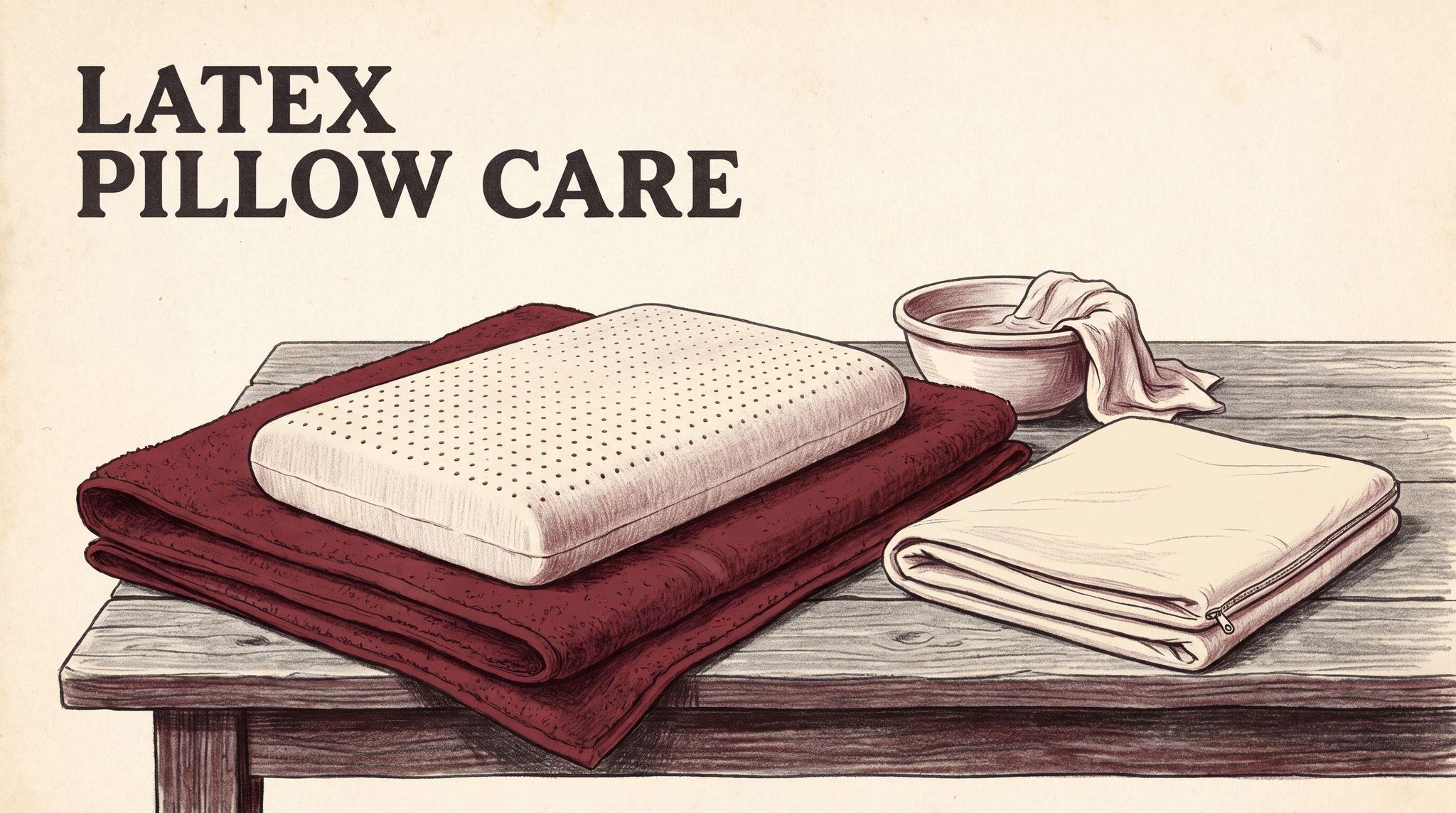
Everyday care is mostly prevention: a washable cover, a protector, airing the core now and then, and keeping it away from sun, heat and water.
The foam core is not the part you wash. DOWNLITE notes that latex cannot be machine-washed, so you rely on protectors to manage moisture and keep the surface fresh (DOWNLITE). PlushBeds recommends a protector as well as a pillowcase, and frequent washing of the case to keep oils away from the pillow (PlushBeds).
Dirt is the smaller risk. Sweat and skin oils only reach the foam through the layers above it, so each extra washable layer you add is cheap insurance. The routine below combines what sellers publish with our own judgement on timing where sellers give none.
| Task | How often | Basis |
|---|---|---|
| Wash the pillowcase | Once a week | Joey |
| Air the bare core indoors, out of sun | While the case is in the wash | Joey |
| Wash the zip cover and protector | Every 2 to 4 weeks | Our judgement |
| Vacuum the core with an upholstery tool | Every 1 to 3 months | Our judgement; method from Tom's Guide |
| Spot clean the core | Only after a spill | The sellers' pages counted below |
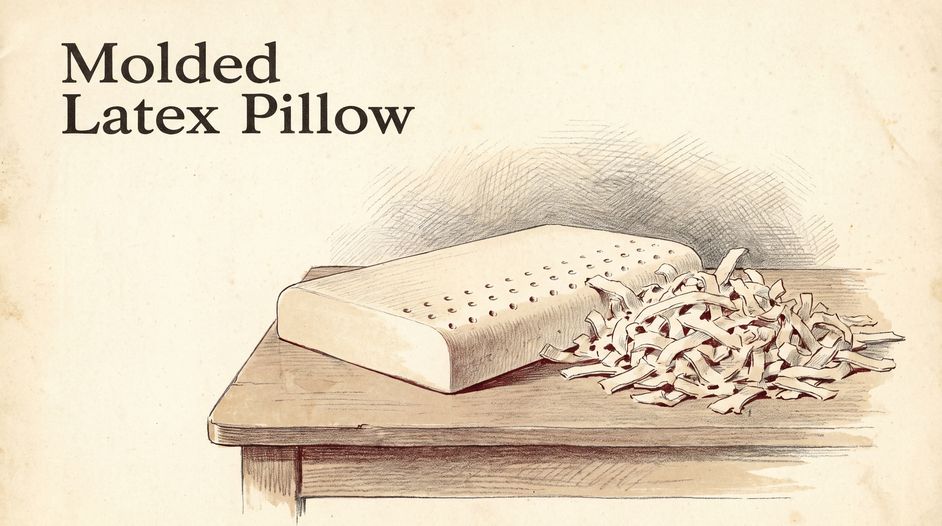
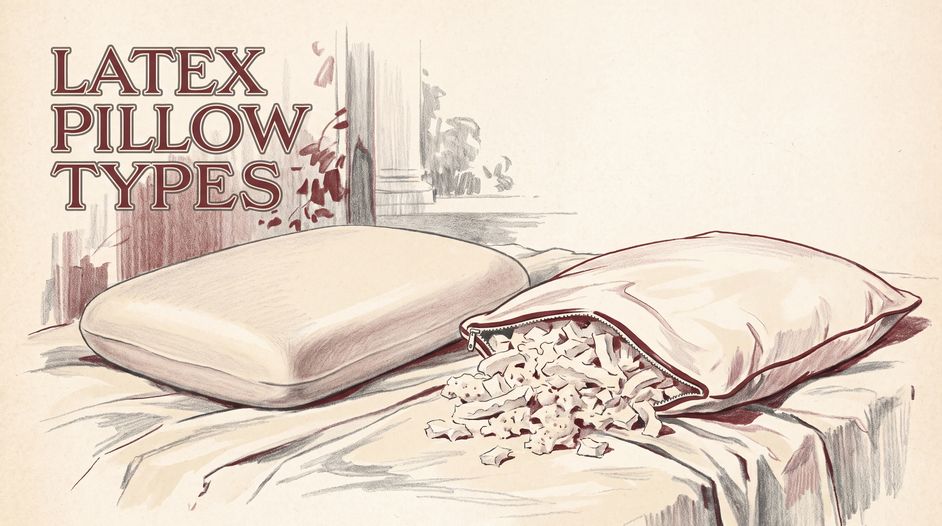
Shredded latex in a zip case follows the same rules for its fill. How shredded and solid latex differ is covered on its own page.
Can you wash a latex pillow, and what do water and heat do to the foam?
The foam core should not go in a washer, dryer or tub. Water soaks in and dries slowly, and agitation and heat can tear or harden the foam.
Not in a machine, and not by soaking. Saatva says the core should never go in a washing machine, and certainly never in a dryer (Saatva). Organic Textiles tells owners not to wash or submerge the core, because too much water can damage the foam's structure (Organic Textiles). Puffy adds that the foam absorbs water quickly, which can lead to deterioration, mold and loss of shape (Puffy).
Wet foam tears easily if you handle it roughly. Joey warns against scrunching, wringing or squeezing wet latex too hard, since that damages it (Joey). Heat is the second thing you need to keep away. Memoe's instructions rule out a heat dryer and dry cleaning, and ask for air drying at room temperature away from sun and heat (Memoe). Even the sellers that allow a hand wash set limits. TLC caps the wash water at 40 °C, warm rather than hot (TLC Latex Pillows).
If a core does get soaked, press the water out between towels, never wring it, and dry it flat indoors. Flobeds suggests drying it indoors out of direct sunlight, using a fan to speed things up (Flobeds). The full answer has its own page, listed under this one.
How do you get a stain or spill out of the foam?
Blot a stain with a cloth dipped in mild soapy water and wrung out, press it dry between towels, then let the core air dry flat in the shade.
How fast you act matters more than how strong the cleaner is. Blot, never scrub. Puffy warns that the pressure of scrubbing can break down the latex structure (Puffy). The method most sellers publish gives you five steps:
- Mix a weak solution. Flobeds suggests about one teaspoon of detergent per gallon of water (Flobeds). Sleep Artisan uses 1 tablespoon of unscented dish detergent in 2 cups of water (Sleep Artisan).
- Dip a cloth and wring it out until it stops dripping.
- Blot from the outside of the stain inward, moving to a clean part of the towel as it lifts the stain (Flobeds).
- Wipe the area with a damp cloth to take off soap residue (Puffy).
- Press dry towels on both sides, then let the pillow air dry flat away from sunlight and heat sources (Organic Textiles).
For a smell rather than a stain, Tom's Guide suggests sprinkling baking soda on the foam and leaving it a few hours before vacuuming it off (Tom's Guide). If you can still smell it after that, repeat the baking soda rather than adding more water. Let the core dry all the way through before it goes back in its cover, because trapped damp is what turns a spill into mildew.
Why does a new latex pillow smell, and how long does the smell last?
The smell comes from sulfur and other volatile compounds in the rubber. Sellers say it fades within a few days of airing out of direct sun.
Natural rubber smells before it ever becomes a pillow. A UNSW thesis on raw natural rubber named methyl mercaptan, dimethyl sulfide, dimethyl disulfide and dimethyl trisulfide as the main sulfur compounds in its emissions (UNSW). It also found terpenes, aldehydes, ketones and acids, compared 14 types of rubber, and reported that much of the sulfur stayed in the solids through to the dried product. That work looked at raw rubber, not finished pillows. It explains where the smell comes from, but it cannot predict how any one pillow will smell.
Here the sellers and the research disagree. One seller describes natural latex pillows as free of chemicals (Bearaby), yet the thesis above lists a range of volatile compounds from natural rubber. The seller's wording is marketing, not a finding, and it only means something when a label names what is kept out, such as flame retardants or formaldehyde. We could not match it to a study of finished latex pillows.
On timing, sellers tell you to expect a short wait. One Talalay listing says the smell fades after 1 to 3 days in a well-ventilated place out of the sun (Amazon listing). PlushBeds says it typically goes within a few days (PlushBeds). Air the bare core indoors with a window open. If the smell lingers for weeks, check the label against what to look for on a low-smell label.
What do sellers' care pages say about washing the core?
Nine care pages read on one day split three ways: most say spot clean only, one calls blotting washing, and two allow a full hand wash.
We read nine sellers' published care instructions for latex pillows on October 20, 2026, and sorted each one by what it tells owners to do with the foam core and water. The count reflects each page's wording alone, and no pillow was handled or cleaned to make it.
| What the page says about the core | Pages | Count |
|---|---|---|
| Spot clean or blot only; no washing machine | Sleeping Organic, PlushBeds, Organic Textiles, a Talalay listing on Amazon, Saatva, Memoe | 6 |
| Says the pillow can be washed, but the method given is blotting with a wrung-out towel | Flobeds | 1 |
| Allows a full hand wash with a rinse | Pillow Talk, TLC Latex Pillows | 2 |
Two patterns stand out. All 9 pages warn against direct sunlight or heat, so that is the one rule nobody disputes. The 2 pages that allow a full hand wash both come from Australian sellers. Pillow Talk describes a gentle hand wash in warm water followed by a cold rinse, and it also says frequent washing may shorten the pillow's life. Read together, the count points you one way: treat the core as spot clean only, and keep a full wash for an accident you cannot blot out.
Why do sunlight and heat matter so much to natural latex?
Natural rubber is attacked by oxygen, and light and heat speed that up, so the foam's surface yellows, stiffens, cracks and crumbles.
Natural rubber's chemistry leaves it open to attack. The main constituent of natural rubber is poly(cis-1,4-isoprene), a highly unsaturated hydrocarbon (Rose and Steinbüchel, 2005). Those double bonds give oxygen a place to strike, and light and heat speed the reaction along.
Heat-aging data show how fast the rubber weakens. A US patent on natural rubber latex film reports that a week in a 70 °C (158 °F) oven, which it equates to 64 months at room temperature, cut the film's tear strength to about half its starting value (US Patent 4,963,623). The same aging cut the stretch of the natural rubber film by 25%. Those were thin films rather than pillows, but foam leaves far more of its surface open to air.
| Exposure | What it does to the foam | Source |
|---|---|---|
| Soaking in water | Damages structure; slow drying invites mold | Organic Textiles, Puffy |
| Washer agitation | Can break up the foam | Turmerry |
| Direct sunlight | Powdery surface | Amazon listing |
| Sun or high heat | Discoloring or brittleness | Organic Textiles |
| Air, over time | Gradual yellowing, called normal | Amazon listing |
You can see the results on the foam itself. TLC warns that too much strong sun eventually makes latex crumble into dust, and asks owners to keep it away from heat and direct sun, even indoors inside a pillowcase (TLC Latex Pillows). So skip the sunny windowsill when you air it, and keep the pillow off radiators.
Does natural latex break down, and what happens to an old latex pillow?
Yes, slowly. Oxygen and light age the foam in use, and some microbes can digest natural rubber, but outside a lab the process is very slow.
Yes, in two ways. In use, oxygen ages the foam slowly, which is why the surface yellows and later crumbles. One seller's listing says latex gradually turns yellow in air over time and calls that normal (Amazon listing).
After disposal, microbes can take over. Microbial rubber breakdown has been studied since 1914, and bacteria break the rubber at the same double bond in its backbone (Rose and Steinbüchel, 2005). In a 1985 culture study, a Nocardia strain used vulcanized natural rubber as food, and a thin latex glove film lost 75% of its weight in 2 weeks (Tsuchii et al., 1985). A pillow core is no thin film. Related work found the rate rose with surface area per unit weight, and short, narrow pieces broke down much more slowly (a follow-up study). Another study says microbes normally break rubber down extremely slowly (Archives of Microbiology).
Blends behave differently. The 1985 strain grew on natural and synthetic isoprene rubber but not on other types of synthetic rubber (Tsuchii et al., 1985). Reading the natural percentage on a label explains how to tell what is in yours.
In the US, your old pillow will most likely go to landfill. The EPA counted 9.2 million tons of rubber and leather in municipal waste in 2018, and the only recycling it identified was tire rubber. Landfills received 5 million tons of it (EPA). Cutting an old core into kneeling pads or craft stuffing keeps it in use a little longer.
How can you tell when a latex pillow is worn out?
A worn pillow shows it: a crumbling or cracked surface, a dent that stays, or a musty smell that returns after the core has dried.
Sellers give you a range, not a date. One seller's guide puts latex at 3 to 4 years and memory foam at 2 to 3 years (Mattress Miracle), while another quotes 7 to 10 years with proper care (Bearaby). Condition says more than age. The table below gives our judgement of what each common sign means. You will not find these calls on a seller's care page.
| Sign | What it likely means (our judgement) | What to do |
|---|---|---|
| Even, light yellowing | Normal surface oxidation | Keep using it |
| Fine crumbs or powder on the cover | Surface breaking down, often from light or heat | Move it out of light; watch whether it spreads |
| Cracks or splits in the foam | The rubber has lost its elasticity | Replace |
| A dent still there the next morning | Cells have broken down in that area | Replace once the height difference is noticeable |
| Musty smell after the core is fully dry | Moisture got in and stayed | Replace; washing will not fix it |
The yellowing row has a seller behind it. One listing says latex oxidizes in air over time and gradually turns yellow, which it calls normal (Amazon listing). The others are judgement. A pillow that sheds crumbs from its core is past saving, and so is one that smells of damp. If you have a history of latex reactions, take any change in the foam to a clinician rather than relying on this table.
Common questions
Short answers to the care questions people ask most often, from pillowcases and vacuuming to sun drying, yellowing, sprays and storage.
Does a latex pillow need a pillowcase over its own cover?
Yes, and a protector between them helps. PlushBeds recommends both a protector and a pillowcase, and frequent washing of the case to keep oils off the pillow (PlushBeds).
Can you vacuum a latex pillow?
Yes. Tom's Guide suggests going over both sides with an upholstery attachment (Tom's Guide). If you own a shredded pillow, use low suction.
Can you dry a wet latex pillow in the sun or the dryer?
No to both. Sellers rule out the dryer, and all 9 care pages we read warn against direct sun. Dry it flat indoors with a fan.
Is it a problem when the foam turns yellow?
Not on its own. Even yellowing is normal oxidation, as the listing cited above says. Crumbling is the sign that matters.
Can you spray disinfectant or fabric freshener on the core?
None of the 9 pages we read recommends a spray for the core. They name mild detergent and water. If you want to freshen the foam, baking soda followed by a vacuum keeps it dry (Tom's Guide).
How should you store a latex pillow you are not using?
Organic Textiles says not to fold or compress the pillow for long periods, and to store it flat (Organic Textiles). Keep it somewhere dark and cool, in a breathable bag rather than sealed plastic.
Sources
Section 9 of this spec: references, numbered in the order they first appear, each tagged with its citing section.
- one seller's listing (amazon.com), cited in “Key Takeaways”; “Why does a new latex pillow smell, and how long does the smell last?”; “What do sellers' care pages say about washing the core?”; “Why do sunlight and heat matter so much to natural latex?”; “Does natural latex break down, and what happens to an old latex pillow?”; “How can you tell when a latex pillow is worn out?”.
- eachnight (eachnight.com), cited in “Key Takeaways”.
- Pillow Talk (pillowtalk.com.au), cited in “Key Takeaways”; “What do sellers' care pages say about washing the core?”.
- US Patent 4,963,623 (image-ppubs.uspto.gov), cited in “Key Takeaways”; “Why do sunlight and heat matter so much to natural latex?”.
- Bearaby (bearaby.com), cited in “Key Takeaways”; “Why does a new latex pillow smell, and how long does the smell last?”; “How can you tell when a latex pillow is worn out?”.
- DOWNLITE (downlitebedding.com), cited in “What does everyday care for a latex pillow involve?”.
- PlushBeds (plushbeds.com), cited in “What does everyday care for a latex pillow involve?”; “Why does a new latex pillow smell, and how long does the smell last?”; “What do sellers' care pages say about washing the core?”; “Common questions”.
- Joey (joeymattress.com), cited in “What does everyday care for a latex pillow involve?”; “Can you wash a latex pillow, and what do water and heat do to the foam?”.
- Tom's Guide (tomsguide.com), cited in “What does everyday care for a latex pillow involve?”; “How do you get a stain or spill out of the foam?”; “Common questions”.
- Saatva (saatva.com), cited in “Can you wash a latex pillow, and what do water and heat do to the foam?”; “What do sellers' care pages say about washing the core?”.
- Organic Textiles (organictextiles.com), cited in “Can you wash a latex pillow, and what do water and heat do to the foam?”; “How do you get a stain or spill out of the foam?”; “What do sellers' care pages say about washing the core?”; “Why do sunlight and heat matter so much to natural latex?”.
- Puffy (puffy.com), cited in “Can you wash a latex pillow, and what do water and heat do to the foam?”; “How do you get a stain or spill out of the foam?”; “Why do sunlight and heat matter so much to natural latex?”.
- Memoe (memoepillow.com), cited in “Can you wash a latex pillow, and what do water and heat do to the foam?”; “What do sellers' care pages say about washing the core?”.
- TLC Latex Pillows (tlclatexpillows.com.au), cited in “Can you wash a latex pillow, and what do water and heat do to the foam?”; “What do sellers' care pages say about washing the core?”; “Why do sunlight and heat matter so much to natural latex?”.
- Flobeds (flobeds.com), cited in “Can you wash a latex pillow, and what do water and heat do to the foam?”; “How do you get a stain or spill out of the foam?”; “What do sellers' care pages say about washing the core?”.
- Sleep Artisan (sleepartisan.com), cited in “How do you get a stain or spill out of the foam?”.
- UNSW (unsworks.unsw.edu.au), cited in “Why does a new latex pillow smell, and how long does the smell last?”.
- Sleeping Organic (sleepingorganic.com), cited in “What do sellers' care pages say about washing the core?”.
- Rose and Steinbüchel, 2005 (pmc.ncbi.nlm.nih.gov), cited in “Why do sunlight and heat matter so much to natural latex?”; “Does natural latex break down, and what happens to an old latex pillow?”.
- Turmerry (turmerry.com), cited in “Why do sunlight and heat matter so much to natural latex?”.
- Tsuchii et al., 1985 (pubmed.ncbi.nlm.nih.gov), cited in “Does natural latex break down, and what happens to an old latex pillow?”.
- a follow-up study (link.springer.com), cited in “Does natural latex break down, and what happens to an old latex pillow?”.
- Archives of Microbiology (link.springer.com), cited in “Does natural latex break down, and what happens to an old latex pillow?”.
- EPA (epa.gov), cited in “Does natural latex break down, and what happens to an old latex pillow?”.
- Mattress Miracle (mattressmiracle.ca), cited in “How can you tell when a latex pillow is worn out?”.
- Organic Textiles (organictextiles.com), cited in “Common questions”.