What is a latex pillow?
Updated .
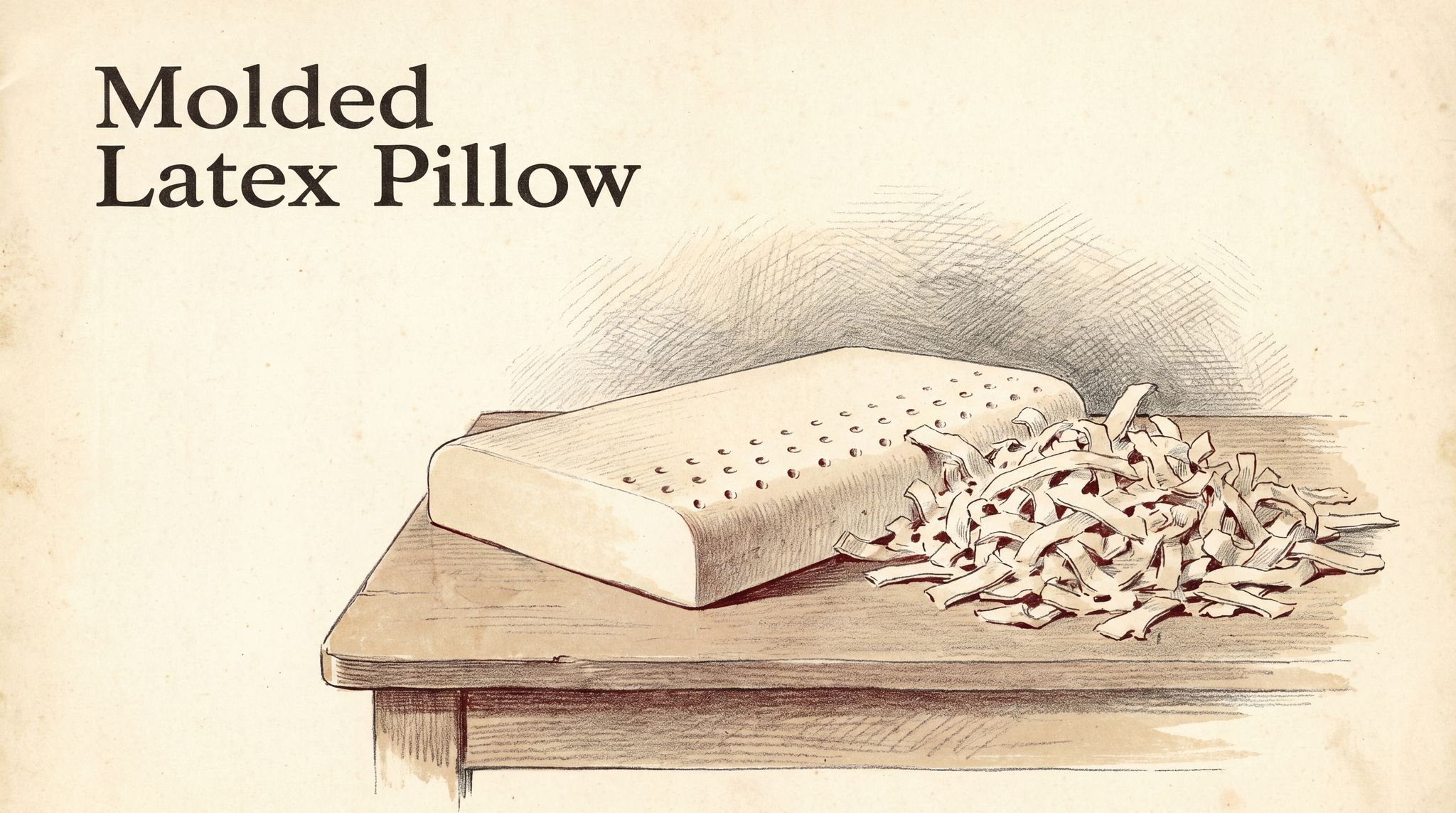
A latex pillow replaces feathers or polyester with foam made from rubber. This page covers what is inside one, how the foam is made and how tall it sits. It also covers what published studies found about neck pain, allergy and dust mites.
Short answer: A latex pillow is filled with latex foam, either as one molded block or as loose shredded pieces, inside a zip cover. The foam comes from rubber tree sap, which is about 60% water and 35% rubber when fresh (PMC review). It can also come from synthetic rubber or a blend. It holds its height without fluffing. In one blinded trial, the latex pillow performed best of five pillows tested (Gordon et al., 2010). People with a latex allergy should ask an allergist first.
This guide is for: people buying their first latex pillow who want to know what they are getting before they compare sellers.
Key Takeaways
- Latex pillows come in 3 forms: a solid Dunlop block, a solid Talalay block, or adjustable shreds. The Talalay method adds a vacuum step and a freeze below the freezing point of water before curing (Google Patents).
- Height is the figure that decides fit, and 5 of the 16 seller pages we read did not state one. All 5 sold Dunlop pillows. Of the 9 Talalay pages, 8 gave two heights in inches.
- Latex allergy is uncommon but real. A systematic review found it in 1.37% of the general population (JACI systematic review). Anyone who has reacted to latex before should get advice first.
On This Page
What is a latex pillow made of?
A latex pillow is a molded block or a bag of shredded foam made from rubber tree sap, synthetic rubber, or a blend, held inside a cover.
Latex starts as the milky sap of the rubber tree. A review of latex allergy puts fresh latex at 60% water, 35% polyisoprene and 5% proteins and lipids (PMC review). Polyisoprene is the rubber itself. The proteins make up only a small share, but they are what an allergic person reacts to. The allergy section below covers that in detail.
Synthetic rubber can be foamed the same way. One seller's help page states that both the Dunlop and Talalay processes can use natural latex, synthetic latex or a blend (Avocado help center). So the phrase "latex pillow" tells you the kind of foam and leaves open where the rubber came from. If the source matters to you, look for the words "100% natural latex" on the page, or a named certificate.
Every latex pillow has two parts. The foam sits inside a zip cover, and one seller's care note says its removable cover is machine washable on cool settings (Soaring Heart). For the longer story of the sap and how it is gathered, read our page on what natural latex is.
How is latex foam made into a pillow?
Liquid latex is whipped into froth, poured into a mold and baked. The Talalay method adds a vacuum and a freeze before the baking step.
Both methods start the same way. The sap is mixed with small amounts of curing agents, frothed, poured into a pillow-shaped mold and heated until it sets. That is the Dunlop process. Sellers describe it as the denser of the two foams.
Talalay adds two steps. Makers fill the mold only partway and seal it under vacuum, so the air bubbles expand to fill the space (LeafScore). A US patent that describes the method says the latex is then cooled below the freezing point of water, and carbon dioxide gas is passed through the foam before it is heated to cure (Google Patents). The freeze holds the bubbles in place before curing, which gives Talalay a lighter and more even feel.
| Step | Dunlop | Talalay |
|---|---|---|
| Froth poured into mold | Mold filled | Mold filled partway |
| Vacuum expansion | No | Yes |
| Freeze before curing | No | Below freezing |
| After curing | Washed and dried | Washed and dried |
| Organic latex certificate | Available | Not currently, per one seller |
Both kinds are washed and dried after baking (LeafScore). The finished foam then goes into a cover, either whole or cut into shreds. Our guide on Talalay, Dunlop, shredded or solid latex compares how the finished pillows feel in use. The short version is that the process changes the feel more than it changes what the pillow is.
What types of latex pillow can you buy?
You can buy three kinds: a solid Dunlop block, a solid Talalay block, or loose shreds you add and remove to set the height yourself.
A solid pillow comes out of the mold as one piece, usually with air holes through it. Its height is fixed, so the seller has chosen it for you. A contour pillow works the same way, with a raised roll along the neck edge.
A shredded pillow holds loose pieces of foam in a zip liner. You open it and take fill out until the height feels right. Back and stomach sleepers usually want less fill than side sleepers, so expect to remove some. One seller ships its adjustable pillow with a spare bag of fill (Naturepedic), which lets you add height back later.
Shreds can mix both foams. One seller states its fill may include Dunlop, Talalay and Talalay infused pieces (Latex Mattress Factory).
| Type | How height is set | Example a seller states |
|---|---|---|
| Solid Dunlop | Fixed by the mold | 5 inches (Latex Mattress Factory) |
| Solid Talalay | Fixed, often in two heights | 4 or 5 inches (Brooklyn Bedding) |
| Shredded | You add or remove fill | 20 by 26 by 5 inches, 2.5 lb (1.14 kg) of latex and wool fill (Natural Linens) |
The choice mostly comes down to control. A solid block gives the same shape every night. Shreds let you correct a height that turns out wrong.
What do latex pillow product pages say about height?
Of 16 seller pages we read, 8 gave two heights, 3 gave one and 5 gave none. All 5 pages with no height sold Dunlop latex pillows.
Our count: On September 27, 2026 we read 16 seller product pages for latex bed pillows sold in the United States, found through two searches for Dunlop and Talalay pillows. We left out marketplace listings and category pages. For each page we noted whether its text stated a height in inches, then sorted it into one of three buckets. We did not handle or measure any pillow. Every figure in the table below comes from reading seller text.
| What the page stated | Pages | Talalay pages | Dunlop pages |
|---|---|---|---|
| Two heights, in inches | 8 | 8 | 0 |
| One height, in inches | 3 | 1 | 2 |
| No height in the text we read | 5 | 0 | 5 |
| Total | 16 | 9 | 7 |
Many pages call height "loft", but this page says height. The Talalay pages gave the clearest figures. Brooklyn Bedding sells a low version at 4 inches and a high one at 5 inches, and suggests the low one for back or stomach sleepers. The Dunlop pages tended to use words like low or plush without giving a figure.
Our reading: height decides whether a pillow fits your neck, and the Dunlop pages we read were the least likely to print it. A page could list a figure in a spec tab we missed, so read the third bucket as "not stated in the main text." If a page gives no height, ask the seller before you order. A single number in inches is a fair thing to expect.
How big is a latex pillow next to a standard pillowcase?
A standard case is 20 by 26 inches. Solid latex cores are often narrower, and the heights sellers list run from about 4 to 7 inches.
In the United States a standard pillow and its case measure 20 by 26 inches. Shredded pillows are usually sewn to that size. One seller lists its standard at 20 by 26 by 5 inches with 2.5 lb (1.14 kg) of fill, a mix of latex pieces and wool (Natural Linens).
Molded pillows are a different story. Several molded cores we read are smaller than a standard case. Bear lists its queen at 16 by 28 by 7 inches (Bear). Talatex lists its standard at 23.6 by 15.7 by 5.9 inches (60 by 40 by 15 cm) (Talatex). Soaring Heart sells its contoured pillow under a standard/queen option, but gives the core as 15 by 23 inches and about 2.5 lb (Soaring Heart).
| Pillow page | Stated size (inches) | Stated weight |
|---|---|---|
| Natural Linens shredded latex and wool, standard | 20 × 26 × 5 | 2.5 lb (1.14 kg) of fill |
| Soaring Heart contoured, sold as standard/queen | 15 × 23 | About 2.5 lb |
| Bear Talalay, queen | 16 × 28 × 7 | Not stated |
| Talatex Talalay, standard | 23.6 × 15.7 × 5.9 | Not stated |
A core that size leaves slack in a standard case, which is normal for a molded pillow. The listed heights across the pages we read ran from 4 inches on one low model (Brooklyn Bedding) to 7 inches on the tallest (Bear). Where a page lists weight, that figure is the only fair way to compare how much fill two shredded pillows hold.
Can a latex pillow help neck pain?
One blinded trial of side sleepers found fewer waking symptoms on a latex pillow than on four others, in people not being treated for neck problems.
The main trial comes from Australia. Researchers ran a random-allocation, blinded field trial with people who slept on their side, used one pillow, and were not being treated for neck or upper back problems. Each person slept a week on each of five pillows: polyester, regular foam, contour foam, feather and latex. Their own pillow served as the control (Gordon et al., 2010).
Two results matter here. About 20% of people reported waking symptoms at least once during the baseline week on their own pillow (Journal of Pain Research). Among the trial pillows, the feather pillow did worst and the latex pillow did best, and the contour foam did no better than the regular foam. The authors concluded that latex pillows can be recommended for control of waking headache and scapular or arm pain.
Read that carefully. The trial tested one latex pillow at one height, in one town, for a week at a time, in people not being treated for neck problems. It does not show that every latex pillow helps. Nor does it show that latex treats neck pain you already have. The result fits the idea that a pillow which holds its height beats one that flattens overnight, though the study did not test the reason.
If you sleep on your side, our guide to choosing a latex pillow for side sleepers covers height in more detail.
Can you use a latex pillow if you have a latex allergy?
Natural latex carries proteins that can trigger allergy. Most people are not allergic, but anyone with a severe reaction should skip it.
Latex allergy is a reaction to proteins in natural rubber. A systematic review found it in 1.37% of the general population and 4.32% of health care workers, who handle latex gloves every day (JACI systematic review). Most people will never react to a latex pillow. The risk is small but not zero.
Latex foam is made from the same sap that carries those proteins, so a pillow made from natural latex can hold them too. We found no study that measured allergen levels in latex pillows. A pillow sits close to your face for hours every night, which argues for extra caution if you already react to latex.
Some people with latex allergy also react to certain fruits. A clinical abstract notes that this latex-fruit syndrome has been described in 30 to 50% of people with latex allergy (PMC abstract). The fruits its patients reacted to included kiwi, peach and chestnut.
Our advice is simple. If you have ever reacted to gloves or balloons, ask an allergist before you buy. If the reaction was severe, choose a pillow with no latex in it, such as one filled with wool or buckwheat hulls. A cover over the foam is not a tested barrier, so do not count on it to protect you.
Do dust mites live in latex pillows?
Sellers make dust mite claims for latex. The pillow studies we found tested only feather and synthetic fills, so those claims rest on sellers.
Many seller pages make claims about dust mites. One Talalay seller says its latex inherently protects against allergens and dust mites (Brooklyn Bedding). That may be true. A seller's statement is still not a measurement.
The pillow studies we found tested other fills. In one, pairs of new synthetic and feather pillows sat on 12 beds for 12 months. By the end, the synthetic pillows held 19.28 µg/g of the main mite allergen, compared with 6.45 µg/g for feather (Rains et al., 1999). The authors also found that how fast a pillow picked up allergen depended on how much was already in the bed.
We found no study that measured mite allergen in latex pillows. So treat seller claims about mites as plausible but unproven. The second finding applies to any pillow, latex included: it takes on the allergen level of the bed it sits in.
Care follows from that. Wash the cover and pillowcase on a regular schedule, because the foam itself cannot go in a washer. One maker says to spot clean the inner pillow only and to let it dry fully before use (Naturepedic). If mites are your main concern, what you do with the bed as a whole will matter more than which fill you pick.
What does natural or organic mean on a latex pillow?
Natural means the rubber came from trees, with no certificate behind it. Organic latex should come with a certificate you can look up by number.
"Natural" on a latex pillow means the rubber came from trees rather than a chemical plant. No certificate stands behind the word, and blends are on sale. The useful question is what share of the foam is natural rubber.
"Organic" has a standard behind it. The Global Organic Latex Standard was developed by the certification body Control Union. When it announced version 3.0, Control Union said the standard certifies foam made with 95% latex rubber sap from certified organic plantations, and can also cover a finished pillow (Control Union via PR Newswire, 2017). The standard also sets limits on harmful substances, requires emission tests, and caps polymer and filler percentages. Transaction certificates trace the latex from plantation to retailer (Control Union).
One seller's help page says certification under that organic latex standard is not currently available for Talalay latex (Avocado help center). If a Talalay pillow is sold as organic, ask which certificate covers the latex.
| Words on the page | What they tell you | What to ask |
|---|---|---|
| Latex | A kind of foam | Natural, synthetic or blend? |
| 100% natural latex | Tree rubber, no blend claimed | Does that cover the core only, or the whole pillow? |
| Organic latex | A certified claim | The certificate number and holder |
| Blended latex | Partly synthetic | What share is natural? |
Common questions
Can you wash a latex pillow?
You can wash the cover but not the foam. One maker says to machine wash the outer cover and spot clean the inner pillow, then let it dry fully before use (Naturepedic). A pillow protector keeps the foam cleaner between washes of the cover.
Can you make a latex pillow lower?
If it is shredded, you can open the liner and take fill out. One seller ships its adjustable pillow with a spare bag of fill, so you can also add height back (Naturepedic). A solid block cannot be changed, so check its listed height before you buy.
Is a latex pillow firm?
Height and firmness are separate things. Dunlop foam is usually sold as the denser of the two, and Talalay as the lighter (LeafScore). A tall latex pillow is not always a hard one, so read both the height and the feel the seller describes.
Will a latex pillow fit a standard pillowcase?
In most cases it will. Shredded pillows are often cut to 20 by 26 inches, and the molded cores we read were mostly smaller than that. Either kind fits a standard American case, and a molded core will simply leave some room at the edges.
How long does a latex pillow last?
We found no study that measured how long latex pillows last. One review lists a 3-year warranty on a Talalay pillow it tested (TechRadar). A warranty sets the minimum the seller will stand behind and says nothing measured about lifespan.
Is a latex pillow the same as memory foam?
No. Latex foam comes from rubber and springs back as soon as you lift your head. Memory foam is a slower foam made from polyurethane. The Australian trial tested two non-latex foam pillows alongside latex, and the latex pillow performed best (Gordon et al., 2010).
Sources
Section 9 of this spec: references, numbered in the order they first appear, each tagged with its citing section.
- PMC review (pmc.ncbi.nlm.nih.gov), cited in “What is a latex pillow made of?”.
- Gordon et al., 2010 (dovepress.com), cited in “Can a latex pillow help neck pain?”; “Common questions”.
- Google Patents (patents.google.com), cited in “Key Takeaways”; “How is latex foam made into a pillow?”.
- JACI systematic review (jacionline.org), cited in “Key Takeaways”; “Can you use a latex pillow if you have a latex allergy?”.
- Avocado help center (help.avocadogreenmattress.com), cited in “What is a latex pillow made of?”; “What does natural or organic mean on a latex pillow?”.
- Soaring Heart (soaringheart.com), cited in “What is a latex pillow made of?”; “How big is a latex pillow next to a standard pillowcase?”.
- LeafScore (leafscore.com), cited in “How is latex foam made into a pillow?”; “Common questions”.
- Naturepedic (naturepedic.com), cited in “What types of latex pillow can you buy?”; “Do dust mites live in latex pillows?”; “Common questions”.
- Latex Mattress Factory (latexmattressfactory.com), cited in “What types of latex pillow can you buy?”.
- Latex Mattress Factory (latexmattressfactory.com), cited in “What types of latex pillow can you buy?”.
- Brooklyn Bedding (brooklynbedding.com), cited in “What types of latex pillow can you buy?”; “What do latex pillow product pages say about height?”; “How big is a latex pillow next to a standard pillowcase?”; “Do dust mites live in latex pillows?”.
- Natural Linens (naturallinens.com), cited in “What types of latex pillow can you buy?”; “How big is a latex pillow next to a standard pillowcase?”.
- Bear (bearmattress.com), cited in “How big is a latex pillow next to a standard pillowcase?”.
- Talatex (talatex.com), cited in “How big is a latex pillow next to a standard pillowcase?”.
- PMC abstract (pmc.ncbi.nlm.nih.gov), cited in “Can you use a latex pillow if you have a latex allergy?”.
- Rains et al., 1999 (onlinelibrary.wiley.com), cited in “Do dust mites live in latex pillows?”.
- Control Union via PR Newswire, 2017 (prnewswire.com), cited in “What does natural or organic mean on a latex pillow?”.
- Control Union (controlunion.com), cited in “What does natural or organic mean on a latex pillow?”.
- TechRadar (techradar.com), cited in “Common questions”.