How is natural latex made, from the tapped tree to the finished core?
Updated .
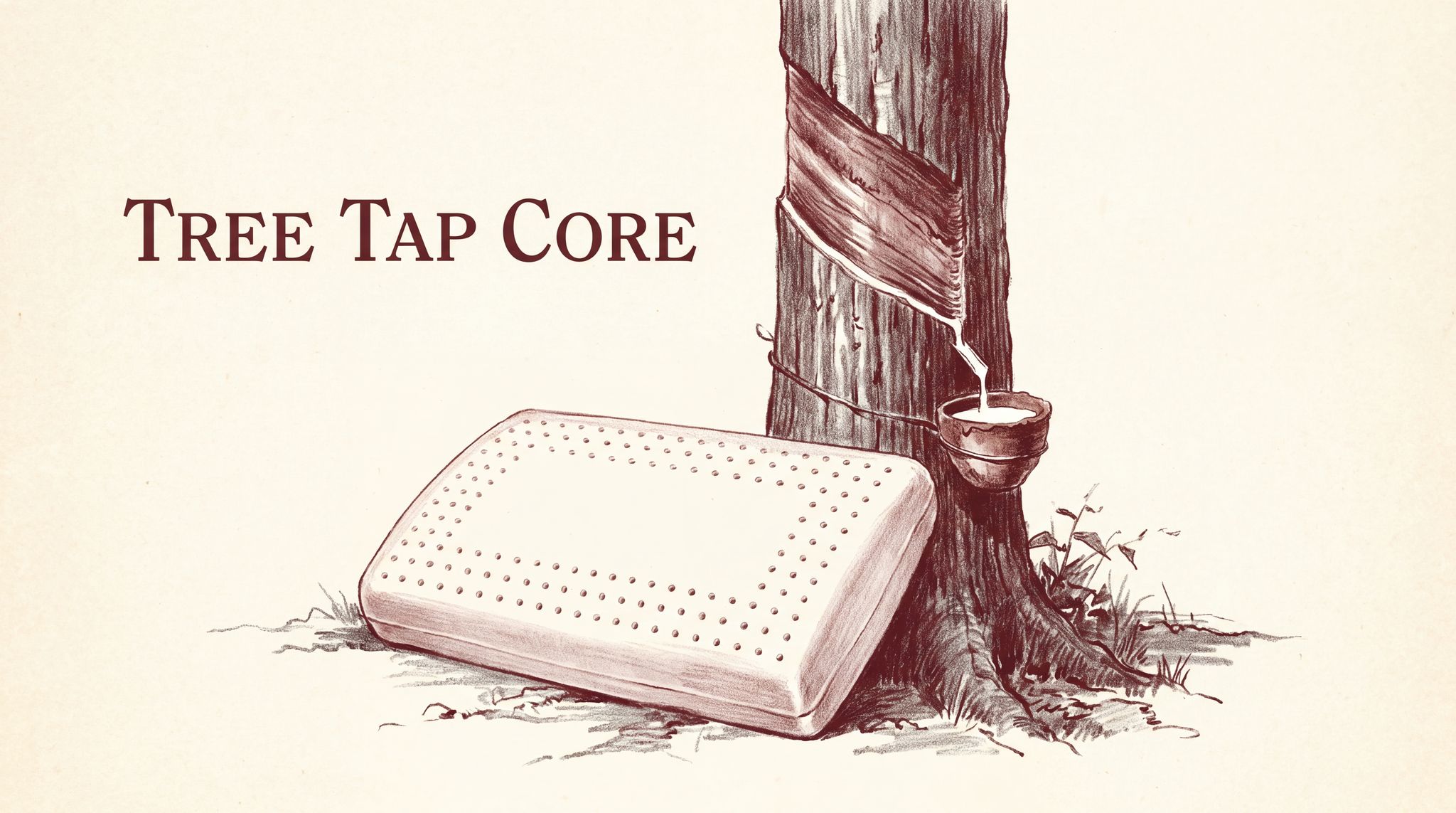
A latex pillow core starts as sap from a tree that has grown for at least 5 years. After that it passes through a field, a centrifuge, a mixing tank, a mold and a washer before it reaches you. This guide takes each stage in order and shows which ones a product listing will tell you about.
Short answer: A tapper cuts a thin groove in the bark of a rubber tree every second day and collects the latex that drips out. Ammonia keeps it liquid, and a centrifuge lifts it from about 30% rubber to about 60%. The factory mixes in soap, sulfur and curing agents, whips it into foam, sets it in a mold and cures it with heat. Talalay adds a vacuum and a deep freeze before curing. Both kinds of core are then washed and dried.
This guide is for: people who want to know what happened to the latex in a pillow before it reached the store, and what a listing can and cannot tell them.
Key Takeaways
Three points carry the whole process: how the tree is tapped, how the latex is concentrated, and what pillow listings leave out.
- A rubber tree is first tapped at 5 or 6 years old. It gives roughly 1.7 ounces (50 g) of solid rubber per tapping, about once every two days, and can stay productive for more than 20 years (Britannica).
- Fresh latex is about 30% rubber. Ammonia at 0.3% to 0.8% by weight keeps it liquid, and a centrifuge concentrates it to the 60% grade that foam makers use (Physics Procedia, 2009).
- Of 21 latex pillow listings we read on September 27, 2026, 1 described a factory step, 14 named only Dunlop or Talalay, and 6 named no process. None mentioned washing the core.
On This Page
The eight sections below follow the latex in order, from the bark of the tree to the listing you read before you buy a pillow.
Where does natural latex come from, and how is it tapped?
Tappers shave a thin slanted groove in the bark of a tree at least 5 years old, every other day, and latex drips into a cup below.
Natural latex is a milky fluid from the rubber tree, Hevea brasiliensis, grown mainly on plantations in Southeast Asia, according to Stalam, an Italian maker of foam-curing equipment. Britannica says a tree starts producing at 5 or 6 years old, and with care it can keep going for more than 20 years.
The cut follows a set pattern. The tapper scores the bark with a knife across half the trunk, slanting it downward, and each new cut sits just below the last. Trees are tapped about once every two days, and each tapping yields roughly 1.7 ounces (50 g) of solid rubber (Britannica). That shallow, repeated cut is why the latex in your pillow can come from a tree that keeps producing for decades.
Timing changes the harvest. The FAO field manual on the rubber tree tells tappers to start at daybreak, because cuts made late in the day collect one third less latex. It also has them pause in the dry season, while the trees shed and regrow their leaves.
Nobody cuts the tree down. Once a tapper has worked down the whole length of bark, the FAO manual says the cycle can begin again higher up the trunk.
For you as a buyer, this first stage decides one label. GOLS certifies finished latex products only when at least 95 percent of the latex in them is organic raw latex (GOLS 3.0). If you want an organic pillow, that claim is won or lost at the tree.
What happens to latex between the tree and the factory?
Fresh latex starts to clot soon after tapping, so collectors add ammonia at the field to keep it liquid until it reaches the processing plant.
Fresh latex is a suspension of tiny rubber particles in water. Britannica puts its rubber content at about 30 percent, and notes that latex leaving a cut in the bark dries into a rubbery film. A factory has no use for a dried film. That is why the latex in any core you buy gets a preservative at the tree, long before it becomes foam.
So preservation starts in the field. A study in Physics Procedia (2009) reports that the ammonia dose runs from about 0.3 to 0.8 percent of the latex by weight, often with a mix of tetramethylthiuram disulfide and zinc oxide. Stalam describes the same practice: the collected liquid is mixed with ammonia and a TMTD and zinc oxide blend to preserve it.
The preserved liquid is a shared raw material. Stalam notes that low-ammonia latex is used for balloons, gloves and sanitary goods as well as mattress cores and pillows. The latex in your pillow starts out as the same grade that goes into a household glove.
Storage time matters as well. The same study tested concentrate stored for up to 45 days, and it cites earlier work showing that gel content in stored latex rises over time.
None of these additives is unusual, but they are why "natural" on a pillow label describes where the rubber came from, not a liquid free of additives.
Why is field latex spun in a centrifuge before it becomes foam?
A centrifuge spins out water and some non-rubber matter, lifting field latex from about 30% rubber to the 60% that foam makers buy.
At 30 percent rubber, field latex is mostly water. The next step concentrates it. The Physics Procedia study states that commercial concentrate is produced by centrifugation, which removes about two thirds of the water-soluble non-rubber substances along with a skim latex of smaller particles. Its trial runs gave concentrate at 60 percent dry rubber content and skim latex at roughly 5 percent.
Pillow listings rarely name this grade, but every core you buy starts from it. ASTM D1076 sorts concentrates by method and preservative: centrifuged latex preserved with low ammonia plus other preservatives, guayule and other natural latex, and more. One category is defined by protein, at under 200 µg of total protein per gram of dry latex.
The organic standard covers this processing step too. Version 3.0 of the Global Organic Latex Standard (GOLS) allows only organic latex from certified sources to be centrifuged, and requires the dry rubber content to be recorded on arrival and after centrifuging.
| Stage | Figure | Source |
|---|---|---|
| Tree first tapped | 5 or 6 years old | Britannica |
| Rubber per tapping | about 1.7 oz (50 g) | Britannica |
| Rubber in fresh latex | about 30% | Britannica |
| Ammonia added in the field | 0.3% to 0.8% by weight | Physics Procedia |
| Rubber after centrifuging | 60% | Physics Procedia |
| Rubber left in skim latex | about 5% | Physics Procedia |
What goes into the latex compound before it is foamed?
Before foaming, the concentrate is mixed with soap, sulfur and curing agents, and some makers blend in synthetic rubber at this stage.
Concentrate is still a liquid, and it will not foam or hold a shape by itself. It has to be compounded first. Latex Sense, a UK seller, says small amounts of other materials are needed in all latex production: natural soaps, sulfur, gelling agents and vulcanization agents. Stalam adds that a pure natural-latex compound is left to mature before it is foamed.
Sulfur does the main work later on. One US seller's explainer describes vulcanization as hardening liquid latex by cross-linking it with sulfur, driven by heat and accelerators such as zinc oxide. That reaction turns a wet foam into an elastic solid.
This is also where a core can stop being all natural. Hüsler Nest, a Swiss bed maker, states that Talalay latex may include a synthetic rubber admixture, or it can consist of 100 percent natural latex. The process name on a listing does not tell you which.
The organic standard sets a hard limit. Under GOLS 3.0, at least 95 percent must be organic raw latex from certified sources, no more than 5 percent can be processing chemicals or fillers, and synthetic latex is not allowed (GOLS 3.0).
If a listing says "100% natural" with no certificate behind it, you are taking the recipe on trust. Our page on what natural latex is explains how the common labels differ.
How does the Dunlop process turn liquid latex into a core?
Dunlop foam is whipped, dosed with a gelling agent, poured into a pinned mold and cured in steam, so it sets in one continuous run.
Dunlop is the older method. Latex Sense calls it the standard technology and dates it to 1929. Stalam sets out the steps: the matured compound is whipped into foam with a mechanical mixer and filled into metal molds, with a gelling agent added to stabilize the foam.
The gelling agent sets the clock. A US patent on latex foam names sodium silicofluoride as the preferred Dunlop gelling agent and advises a pot life of 5 to 20 minutes, the working time before the foam sets.
Heat comes next. The molds go into a steam oven or tunnel, and because foam insulates well, the molds carry a large number of pins that carry heat into the middle of the core. Latex Sense gives its oven as steam at 212 °F (100 °C), with the cure taking about 50 minutes.
Dunlop foam is never frozen while it gels. Latex Sense explains that Talalay's freezing step stops the latex particles from settling at the bottom. Sellers such as Talatex describe Dunlop as the denser, firmer of the two. The feel you get from a Dunlop pillow partly comes from that simpler, faster route.
If you are choosing between the two, our guide to Talalay, Dunlop, shredded and solid latex pillows covers how each one feels in use.
How is the Talalay process different from Dunlop?
Talalay adds two steps before curing: a vacuum swells foam in a part-filled mold, and a deep freeze holds the bubbles in place.
Talalay begins like Dunlop, with a whipped compound poured into a mold. The difference is that the mold is only partly filled. Hüsler Nest describes the sequence: the mold is sealed, a vacuum makes the air bubbles swell until the foam fills it, and the mold and foam are then frozen to -18 °F (-28 °C). Carbon dioxide is forced through the frozen foam and forms carbonic acid, which shifts the pH from over 10 to 7 and makes the foam gel. Only then is the mold warmed in stages to a curing temperature of 239 °F (115 °C).
The real difference is how the foam gels. A US patent on foam additives describes both routes: Talalay gels with carbon dioxide and is then raised to about 230 °F to cure, while Dunlop gels with chemical additives such as sodium fluorosilicate.
The extra steps cost time and power. Latex Sense claims Talalay takes four times longer and uses five times more energy than Dunlop. That figure comes from a seller, not a published study, so treat it as a rough guide. If you prefer a lighter, springier pillow, these steps are what you are paying for.
| Step | Dunlop | Talalay |
|---|---|---|
| Foaming | Whipped in a mixer | Whipped, then swelled by vacuum |
| Mold | Filled | Part-filled, then sealed |
| How it gels | Gelling agent such as sodium silicofluoride | Frozen, then carbon dioxide |
| Cure, as sources report it | Steam at 212 °F (100 °C) | Warmed to 239 °F (115 °C) |
| After curing | Washed and dried | Washed and dried |
Why are latex cores washed and dried after curing?
After curing, each core is pulled from its mold, washed, dried with heat, then checked for hardness and weight before it is finished.
Both methods end the same way. Stalam's summary: once vulcanized, the pillow or mattress core is stripped from the mold, washed, dried and made ready for sale. Latex Sense adds a quality check of hardness, weight and appearance before finishing.
Washing matters most to people who react to latex. The allergy is caused by water-soluble proteins in the sap, according to a US patent on reducing latex allergens. A review in the Journal of Allergy and Clinical Immunology states that the protein content of Hevea latex products can be reduced considerably by washing, heat treatment, chlorination and enzyme digestion. The patent notes that repeated washing and centrifuging can remove up to 100 percent of the water-soluble protein from latex, though each wash lowers the yield and raises the cost.
That trade-off makes washing worth asking about. It costs the maker money, and you cannot see it in the finished core. If you have reacted to latex gloves, ask about this step before any other.
None of this makes a latex pillow suitable for someone with a diagnosed latex allergy. Ask a clinician, not a product page.
Shredded fill goes through one more step. One US seller of pillow kits says its shreds are offcuts from mattress pieces made in Sri Lanka (DIY Natural Home). Its standard 20 by 26 inch kit uses 4.5 pounds of fill.
What can a pillow listing tell you about how its core was made?
Most listings we read name Dunlop or Talalay and stop there, leaving out washing, curing heat and how long the foam spent in its mold.
We read 21 single-product pages for latex pillows sold to US buyers, found through three searches on September 27, 2026. For each one we counted what it said about how its core was made. We counted only the product text we could read. The latex pillows in our picks were bought and handled, but nothing was tested.
| What the page said about the core | Pages |
|---|---|
| Named Dunlop or Talalay and described at least one factory step | 1 |
| Named Dunlop or Talalay but described no step | 14 |
| Named no process at all | 6 |
The one page that described a step, a Talalay pillow listing, says the latex is vacuum-sealed, flash-frozen and then vulcanized.
All 6 pages that named no process sold shredded-fill pillows. None of the 21 pages mentioned washing the core as a factory step.
The table below gives our own judgement of what each stage changes and how much a listing lets you check.
| Stage | What it can change | Can a listing show it? (our judgement) |
|---|---|---|
| Raw latex | Whether an organic claim is possible | Only if it names a GOLS certificate covering that product |
| Compounding | Whether synthetic rubber is blended in | Only with a certificate or a plain "no synthetic" line |
| Dunlop or Talalay | Density and feel | Usually; 15 of 21 pages named one |
| Washing | Leftover soluble protein | No; 0 of 21 pages mentioned it |
If washing or protein matters to you, ask the seller in writing. Our checklist for an organic latex standard bed pillow lists the documents to request.
Common questions
Short answers on tapping, how much latex a pillow holds, curing time, organic claims and whether a latex core can be washed at home.
Is the tree cut down to harvest latex?
No. Tapping removes a thin strip of bark, and Britannica says a tapped tree can stay productive for more than 20 years with care.
How much tapping goes into one pillow?
Only roughly. A standard 20 by 26 inch shredded pillow holds about 4.25 pounds of fill (Lifekind). At about 1.7 ounces of rubber per tapping, that much fill works out to several dozen tappings, before counting other ingredients.
How long does a Dunlop core take to cure?
Latex Sense, the UK seller cited above, gives about 50 minutes in steam at 212 °F (100 °C). Talalay takes longer because of its vacuum and freezing steps.
Is Talalay less natural than Dunlop?
Not because of the process. Hüsler Nest notes that Talalay can be 100 percent natural or can contain synthetic rubber, so the recipe decides it, not the method.
Does GOLS cover the factory or only the latex?
It covers both. GOLS certifies finished latex products, and version 3.0 requires annual audits of collection points, centrifuging units, factories, retailers and brand owners. A certified factory can still sell uncertified products, so check that the certificate names the product.
Can you wash a latex pillow core at home?
Most sellers say no. One warns against machine washing or soaking the latex and recommends spot cleaning with a mild detergent and water (PlushBeds).
Sources
Section 9 of this spec: references, numbered in the order they first appear, each tagged with its citing section.
- Britannica (britannica.com), cited in “Key Takeaways”; “Where does natural latex come from, and how is it tapped?”; “What happens to latex between the tree and the factory?”; “Why is field latex spun in a centrifuge before it becomes foam?”; “Common questions”.
- Physics Procedia, 2009 (sciencedirect.com), cited in “Key Takeaways”; “What happens to latex between the tree and the factory?”; “Why is field latex spun in a centrifuge before it becomes foam?”.
- Stalam, an Italian maker of foam-curing equipment (trends.directindustry.com), cited in “Where does natural latex come from, and how is it tapped?”.
- FAO field manual on the rubber tree (fao.org), cited in “Where does natural latex come from, and how is it tapped?”.
- GOLS 3.0 (mmx.prnewswire.com), cited in “Where does natural latex come from, and how is it tapped?”; “Why is field latex spun in a centrifuge before it becomes foam?”; “What goes into the latex compound before it is foamed?”.
- ASTM D1076 (store.astm.org), cited in “Why is field latex spun in a centrifuge before it becomes foam?”.
- Latex Sense, a UK seller (latexsense.co.uk), cited in “What goes into the latex compound before it is foamed?”.
- One US seller's explainer (sleeponlatex.com), cited in “What goes into the latex compound before it is foamed?”.
- Hüsler Nest, a Swiss bed maker (huesler-nest.ch), cited in “What goes into the latex compound before it is foamed?”.
- US patent on latex foam (image-ppubs.uspto.gov), cited in “How does the Dunlop process turn liquid latex into a core?”.
- Talatex (talatex.com), cited in “How does the Dunlop process turn liquid latex into a core?”.
- US patent on foam additives (image-ppubs.uspto.gov), cited in “How is the Talalay process different from Dunlop?”.
- US patent on reducing latex allergens (image-ppubs.uspto.gov), cited in “Why are latex cores washed and dried after curing?”.
- Journal of Allergy and Clinical Immunology (jacionline.org), cited in “Why are latex cores washed and dried after curing?”.
- DIY Natural Home (diynaturalhome.com), cited in “Why are latex cores washed and dried after curing?”.
- Talalay pillow listing (talatex.com), cited in “What can a pillow listing tell you about how its core was made?”.
- Lifekind (lifekind.com), cited in “Common questions”.
- PlushBeds (plushbeds.com), cited in “Common questions”.