How do you read a pillow's ILD, and why can the same number feel different in two pillows?
Updated .
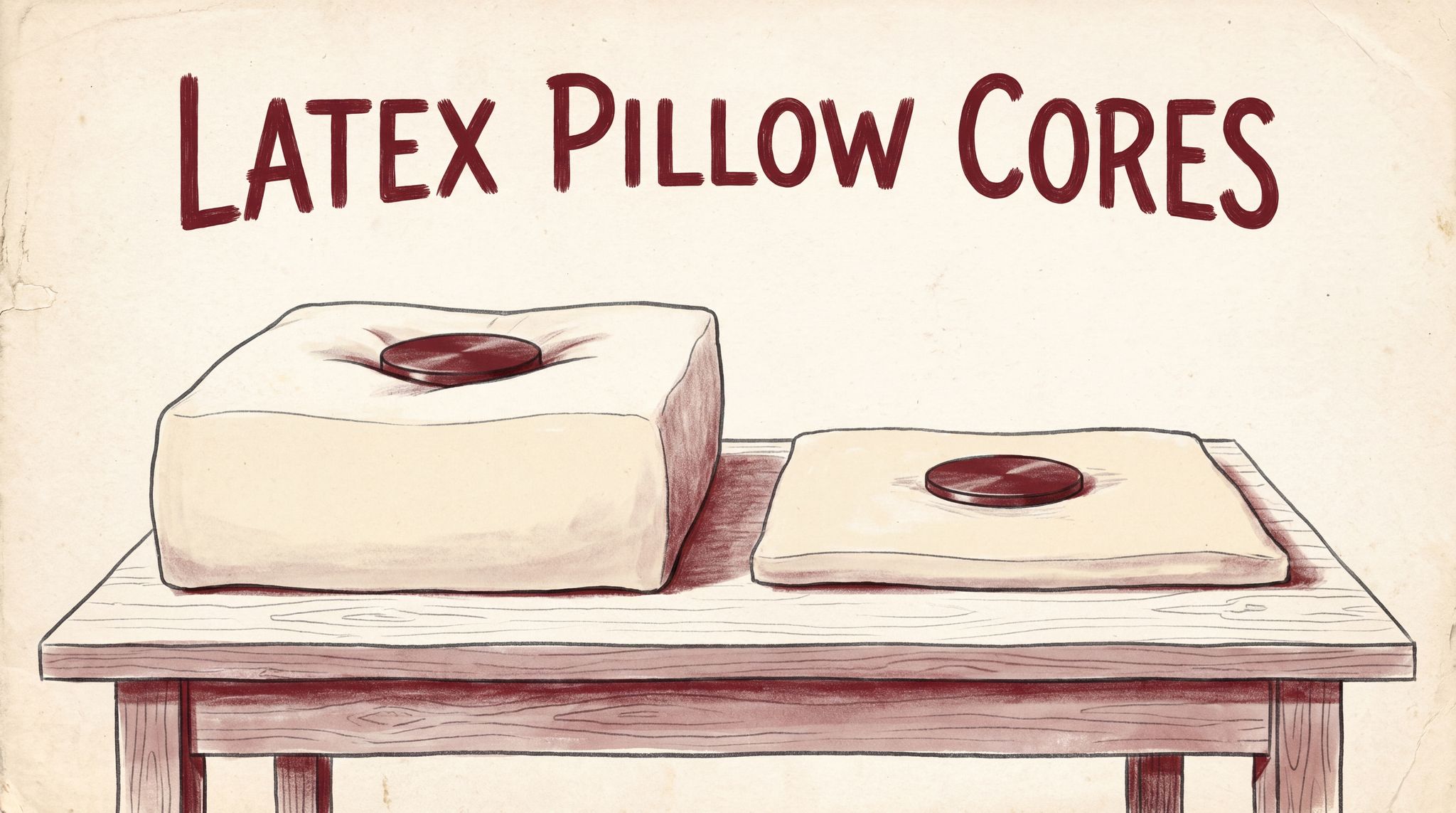
Some latex pillow listings print an ILD number as if that settles how firm the pillow is. The number comes from a slab test. Under ASTM D3574, a flat indenter 8 inches across, with a face of 50 square inches, presses into a foam sample usually 100 mm thick (Wikipedia), which is about 4 inches (Natural Mattress Finder). The force is read 60 seconds after the indenter reaches 25% of the thickness (Wikipedia). Pillow cores are a different size. One maker sells a core 2.6" tall (Talatex), and another sells one 16" x 28" x 7" (Bear). Most sellers also leave out which test they ran.
Short answer: Treat ILD as a fact about the latex, not about the pillow. Under ASTM D3574 it is the force in pounds that pushes a 50-square-inch disc 25% of the way into a sample 4 inches thick. The same number feels different when two cores differ in thickness, holes or shape, when two sellers used different tests, or when two foams stiffen at different rates past that first 25%. Compare ILD only inside one seller's range, and choose the height first.
This guide is for: people comparing solid latex pillows whose listings print an ILD number, or who have been told that one number means soft and another means firm.
Key Takeaways
Three points do most of the work. They cover what the number measures, why pillows don't meet the test's assumptions, and what our count of listings found.
- ILD is a slab test, not a pillow test. Under ASTM D3574 a flat disc 8 inches across, with a 50-square-inch face, presses 25% into a sample usually 100 mm thick, and the force is read after 60 seconds (Wikipedia). That sample is about 4 inches thick (Natural Mattress Finder), while pillow cores run from 2.6 inches (Talatex) to 7 inches (Bear).
- Seller scales do not line up. One seller lists its soft pillow at 24 ILD (Avocado). Another lists 17-20 for the core it designs to give the most support (Talatex). Neither page we read says which test produced its figure.
- Most listings give no number at all. We read 13 solid latex pillow pages on September 27, 2026. Of those, 4 stated an ILD figure, 6 gave only a firmness word, and 3 gave height or shape with no firmness claim.
On This Page
The eight sections below go from what the test does, through the ways pillows differ from it, to how to use a listed number when you shop.
The first two sections explain the test itself. Sections three to five cover the gaps between a slab in a lab and a core under your head. Section six puts published figures side by side, and section seven reports our count of listings. The last section turns all of this into an order for buying decisions.
What does ILD measure in a latex pillow?
ILD is the force in pounds needed to press a slab of foam down by a quarter of its thickness. A higher number means firmer latex.
ILD stands for indentation load deflection. The foam industry's trade body describes firmness as an indicator of the foam's surface feel. It measures it as the force in pounds needed to indent a sample by 25% of its original height, and calls this measurement IFD (Polyurethane Foam Association). ILD and IFD are two names for the same reading. Lower scores mean less firmness and higher scores mean greater firmness (Indentation force-deflection).
The number describes the surface of the latex, not the whole pillow. It tells you how hard the first quarter of the foam pushes back. A second reading at 65% of the height shows how the foam carries weight further down. The 65% figure divided by the 25% figure is called the support factor, and for foams it runs from about 1.5 to 2.6 (PFA). A foam with a high support factor gets stiffer the further it is pressed.
Density is a separate property. The PFA says firmness is independent of density (PFA). A light foam can be firm, depending on the IFD it was made to. A dense foam can still be soft. Some pillow listings print density and ILD side by side, and it is easy to read one as standing in for the other. An ILD figure is most useful as a fact about the latex itself. It describes the foam before the seller cut it, cored it, shaped it and put a cover on it.
How is the ILD test done under ASTM D3574?
A flat 8-inch disc presses a 4-inch slab down 25% and the force is read a minute later, after the foam has been flexed and rested.
The indenter in ASTM D3574 is a flat disc 8 inches across with a face of 50 square inches, and the sample is usually 100 mm thick and 500 mm by 500 mm (Wikipedia). The foam sits on a perforated table so air can escape. It is warmed up by being compressed twice to 75% and then left to recover for six minutes. The force is read 60 seconds after the indenter reaches 25% (Wikipedia). A second reading follows at 65% of the original thickness, again after about one minute (ADMET).
Each condition is fixed so that two labs testing the same foam get the same answer. A pillow meets few of them. The international method works differently. ISO 2439 Method A measures a 40% indentation with a 30-second hold (ZwickRoell). European results are given in newtons rather than pounds (Wikipedia).
| Condition | ASTM D3574 Test B1 | A solid latex pillow in use |
|---|---|---|
| Thickness | Usually 100 mm, about 4 in (Wikipedia, Natural Mattress Finder) | 2.6 in (7 cm) to 7 in, depending on the listing (Talatex, Bear) |
| Footprint | 500 x 500 mm (Wikipedia) | 16 x 24.5 in to 16 x 28 in for queen cores (Bear) |
| What presses | Flat 8-in disc, 50 sq in (Wikipedia) | A rounded head, with the neck below it |
| Depth read | 25%, then 65% (PFA) | However far the head sinks |
| Timing | Force read at 60 seconds (Wikipedia) | A whole night |
| Units | Pounds (ISO 2439 reads 40% and Europe reports newtons) (ZwickRoell, Wikipedia) | None printed on the pillow |
Why can two pillows with the same ILD feel different?
The number fixes one property of the latex, while the core's thickness, holes, shape, cover and deeper stiffness all change what your head meets.
It helps to start with what the test holds constant and then ask what the pillow changes. Four things sit between the printed figure and your head.
The first is depth. Two foams can give the same reading at 25% and different readings at 65%. The PFA notes that a low 25% IFD can be paired with a high support factor. That gives extra surface softness without the foam bottoming out under weight (PFA). One pillow then feels soft and stays soft. Another with the same number feels soft at first and then firms up as your head settles.
The second is holes. A US patent on pillow selection notes that an array of vertical holes, for example 5 mm across, and horizontal channels both reduce the effective hardness (Google Patents). Many cores are cored this way. One seller describes a pinhole design and open cell structure in its pillow (Sleep On Latex). So an ILD taken on solid slab stock can overstate how firm the finished core feels.
The third is shape and thickness, covered in the next section. A contoured core has two heights, so the same latex meets your neck at two different depths.
The fourth is the process. One seller describes Dunlop latex as denser and firmer and Talalay as softer and more responsive (Latex For Less). The two processes are compared in our guide to Talalay, Dunlop, shredded and solid latex pillows. A cover and a tight pillowcase add one more layer on top.
Does pillow thickness change how firm an ILD feels?
Yes. A quarter of a thin core is a short distance, so the same latex runs out of travel sooner and feels firmer under the weight of a head.
Thickness is the test condition that pillows break most often. The test assumes a sample about 4 inches thick (Natural Mattress Finder). A quarter of a 2.6-inch core is about 0.65 inch, while a quarter of a 5.9-inch core is about 1.5 inches. That is our arithmetic, using heights from one maker's own pages (Talatex flat, Talatex soft). Under the same head, the thin core has less foam to spread the load, so it reaches its stiff range sooner. It feels firmer than a thick core cut from the same latex.
A few sellers publish the figure that matters more: the height a core keeps when a head is on it. One maker lists its soft core at 15cm unused and 9-11cm in use (Talatex). Its firmer core keeps 13-14cm in use (Talatex). That drop tells you more about where your neck ends up than the ILD printed beside it. If you sleep on your side and need a tall pillow that holds its height, our guide on latex pillows for side sleepers covers it in more detail.
In inches, by our arithmetic, the soft core goes from 5.9 inches to between 3.5 and 4.3 inches under a head. The firmer core holds 5.1 to 5.5 inches.
Are ILD numbers from different sellers comparable?
Only when both sellers used the same test on the same sample size, which listings almost never say, so treat a number as a rank within one range.
You can compare two figures only if they came from the same method, and listings rarely say which method they used. ASTM D3574 reads the force 60 seconds after a 25% indentation, and US results are given in pounds-force (Wikipedia). ISO 2439 Method A reads a 40% indentation held for 30 seconds (ZwickRoell), and European results are given in newtons. A reading at 40% sits further up the curve than one at 25%. So the same foam can produce two numbers that look unrelated. A summary of the standard adds that its results apply only to the stated test conditions and in general should not be used directly for design (STEP Lab).
Pillow makers have used other conventions as well. A US patent on pillow selection describes a latex pillow rating based on compressing a block about one foot square and eight inches thick by 40%, with very soft pillows typically at 6-8 and hard ones at 10-15 (Google Patents). The digits look alike. On that scale, though, a hard pillow carries a smaller number than most soft mattress latex.
Mattress-layer scales run much higher. One layer seller lists soft at 19 ILD, medium at 28, firm at 38 and extra firm at 44 (Latex Mattress Factory). If you carry a number from your mattress over to a pillow, you may be comparing figures produced by a different test altogether.
What ILD numbers do latex pillow sellers publish?
The few that publish one use very different scales: one seller's soft pillow reads higher than another seller's firm core.
The scales do not meet. One US seller lists its medium pillow at 28 ILD and its soft pillow at 24 ILD (Avocado). A Thai maker lists its soft core at 45 kg/m³ and ILD 9-12 (Talatex), its flat core at 55 kg/m³ and ILD 13-16 (Talatex), and the core designed to give the most support at 65 kg/m³ and ILD 17-20 (Talatex).
Taken at face value, the second maker's most supportive core is softer than the first maker's soft pillow. The more likely explanation is that the two sellers produced their figures under different tests or on different sample sizes. Neither page, in what we read, names its method. By our arithmetic, at 1 kg/m³ to 0.0624 lb/ft³, the three densities come to about 2.8, 3.4 and 4.1 lb/ft³.
| Seller page | Seller's word | ILD stated | Density stated | Height stated |
|---|---|---|---|---|
| Avocado Pure Talalay | Soft | 24 | Not in what we read | Not in what we read |
| Avocado Pure Talalay | Medium | 28 | Not in what we read | Not in what we read |
| Talatex Premium, soft option | Soft | 9-12 | 45 kg/m³ | 5.9 in (15 cm) |
| Talatex Flat | Medium-soft | 13-16 | 55 kg/m³ | 2.6 in (7 cm) |
| Talatex Premium, firm option | Most support | 17-20 | 65 kg/m³ | 5.9 in (15 cm) |
Inside the second maker's line, ILD, density and height in use all rise together, so its own three cores are easy to rank. The trouble starts when a number is carried from one seller to another.
How many latex pillow listings state an ILD?
Few do. Of 13 solid latex pillow pages we read, 4 gave an ILD figure, 6 gave only a firmness word and 3 gave height with no firmness claim.
We read 13 sellers' own product pages for solid latex pillows on September 27, 2026, and sorted each page by what it says about firmness. This block is counting, not testing. The pillows in our picks were bought and handled, but we took no readings.
| What the page states | Pages | Which pages |
|---|---|---|
| An ILD figure | 4 | Avocado; Talatex Premium on two listings (one, two) and Talatex Flat |
| A firmness word only | 6 | Sleep EZ Talalay latex pillow; Latex Mattress Factory Talalay and Dunlop; Turmerry; Foam By Mail; Sleep On Latex |
| Height or shape only | 3 | Helix Talalay latex pillow; Bear; Brooklyn Bedding |
None of the 4 pages that give an ILD states the test standard, the deflection or the sample thickness behind the figure. Three of the four come from one maker. The most common firmness signal was a word. One page offers a 4.5" Super Soft core and a 6" Medium-Plush core (Latex Mattress Factory). A word like that only ranks pillows inside one seller's own line.
How should you use ILD when choosing a latex pillow?
Pick the height your neck needs first, then use ILD only to rank firmness inside one seller's range, and ask which test produced the figure.
Put height first. A 2023 clinical paper summarizes a 2021 systematic review that found moderate evidence for a latex material, a contoured design, a 7-11 cm pillow height and a cooling surface. The same Japanese team treats height as the most important parameter and chooses firmness and material afterward, to hold the adjusted height (Journal of Physical Therapy Science, 2023). In a lab study, subjects lay on pillows from 110 mm to 170 mm tall. Average cranial pressure at 170 mm was about 30% higher than at 110 mm (PeerJ, 2016).
ILD comes second. Use it to separate cores within one seller's line, never across sellers. If you are choosing between the two ends of one range, our guide to a firm latex pillow or a soft one sets out the trade-off.
How much a listed number tells you (our judgement; no maker publishes this):
| What the listing gives | What it tells you | What to do |
|---|---|---|
| Two ILDs, same seller, same shape and height | A fair rank from softer to firmer | Choose within the line |
| Two ILDs, same seller, different heights | Part of the picture; the thinner core feels firmer | Compare height in use if listed |
| ILDs from two sellers | Very little | Ask for the test standard, deflection and sample thickness |
| A firmness word only | A rank inside that seller's line | Ask for the height in use |
| Height in use | The figure the neck research points to | Match it to your build and sleep position first |
Common questions
Short answers to the questions people ask most often once they have seen an ILD number printed on a solid latex pillow listing.
Is a higher ILD always a firmer pillow?
Within one seller's line and one core shape, yes. Across sellers, no. One maker's most supportive core is listed at 17-20 while another seller's soft pillow is listed at 24, which points to different test conditions.
Is ILD the same thing as IFD?
Yes. Both name the force in pounds needed to indent foam by 25% of its height, and the foam trade body calls it IFD (PFA). Latex sellers tend to write ILD instead.
What ILD counts as soft for a pillow?
There is no shared cut-off. Soft means 24 on one seller's page and 9-12 on another's. Read the word and the number only against the same seller's other pillows.
Does density tell you how firm latex is?
Not on its own. The PFA says firmness is independent of foam density (PFA). Within one maker's line the two often rise together, but a density figure can't be carried across sellers any more than an ILD can.
Does a shredded latex pillow have an ILD?
The foam it was shredded from may have one, but the pillow does not behave like a slab. How firm it feels depends on how much fill is in the case. One seller lists a shredded pillow with a total thickness of 5-7” that can be adjusted (Sleep Majestic).
Should side sleepers choose a high ILD?
Choose the height first. A firmer core keeps more of its height under a head, which helps a side sleeper. The clinical advice is to set the height and then pick a firmness that keeps it (Journal of Physical Therapy Science, 2023).
Sources
Section 9 of this spec: references, numbered in the order they first appear, each tagged with its citing section.
- Wikipedia (en.wikipedia.org), cited in “Key Takeaways”; “What does ILD measure in a latex pillow?”; “How is the ILD test done under ASTM D3574?”; “Are ILD numbers from different sellers comparable?”.
- Natural Mattress Finder (naturalmattressfinder.com), cited in “Key Takeaways”; “How is the ILD test done under ASTM D3574?”; “Does pillow thickness change how firm an ILD feels?”.
- Talatex (talatex.com), cited in “Key Takeaways”; “How is the ILD test done under ASTM D3574?”; “Does pillow thickness change how firm an ILD feels?”; “What ILD numbers do latex pillow sellers publish?”; “How many latex pillow listings state an ILD?”.
- Bear (bearmattress.com), cited in “Key Takeaways”; “How is the ILD test done under ASTM D3574?”; “How many latex pillow listings state an ILD?”.
- Avocado (avocadogreenmattress.com), cited in “Key Takeaways”; “What ILD numbers do latex pillow sellers publish?”; “How many latex pillow listings state an ILD?”.
- Talatex (talatex.com), cited in “Key Takeaways”; “Does pillow thickness change how firm an ILD feels?”; “What ILD numbers do latex pillow sellers publish?”; “How many latex pillow listings state an ILD?”.
- Polyurethane Foam Association (pfa.org), cited in “What does ILD measure in a latex pillow?”; “How is the ILD test done under ASTM D3574?”; “Why can two pillows with the same ILD feel different?”; “Common questions”.
- ADMET (admet.com), cited in “How is the ILD test done under ASTM D3574?”.
- ZwickRoell (zwickroell.com), cited in “How is the ILD test done under ASTM D3574?”; “Are ILD numbers from different sellers comparable?”.
- Google Patents (patents.google.com), cited in “Why can two pillows with the same ILD feel different?”; “Are ILD numbers from different sellers comparable?”.
- Sleep On Latex (sleeponlatex.com), cited in “Why can two pillows with the same ILD feel different?”; “How many latex pillow listings state an ILD?”.
- Latex For Less (latexforless.com), cited in “Why can two pillows with the same ILD feel different?”.
- Talatex soft (talatex.com), cited in “Does pillow thickness change how firm an ILD feels?”; “What ILD numbers do latex pillow sellers publish?”; “How many latex pillow listings state an ILD?”.
- STEP Lab (step-lab.com), cited in “Are ILD numbers from different sellers comparable?”.
- Latex Mattress Factory (latexmattressfactory.com), cited in “Are ILD numbers from different sellers comparable?”.
- Talalay (latexmattressfactory.com), cited in “How many latex pillow listings state an ILD?”.
- Dunlop (latexmattressfactory.com), cited in “How many latex pillow listings state an ILD?”.
- Turmerry (turmerry.com), cited in “How many latex pillow listings state an ILD?”.
- Foam By Mail (foambymail.com), cited in “How many latex pillow listings state an ILD?”.
- Brooklyn Bedding (brooklynbedding.com), cited in “How many latex pillow listings state an ILD?”.
- Journal of Physical Therapy Science, 2023 (pmc.ncbi.nlm.nih.gov), cited in “How should you use ILD when choosing a latex pillow?”; “Common questions”.
- PeerJ, 2016 (pmc.ncbi.nlm.nih.gov), cited in “How should you use ILD when choosing a latex pillow?”.
- Sleep Majestic (sleepmajestic.com), cited in “Common questions”.