How do you choose a latex pillow for side sleepers?
Updated .
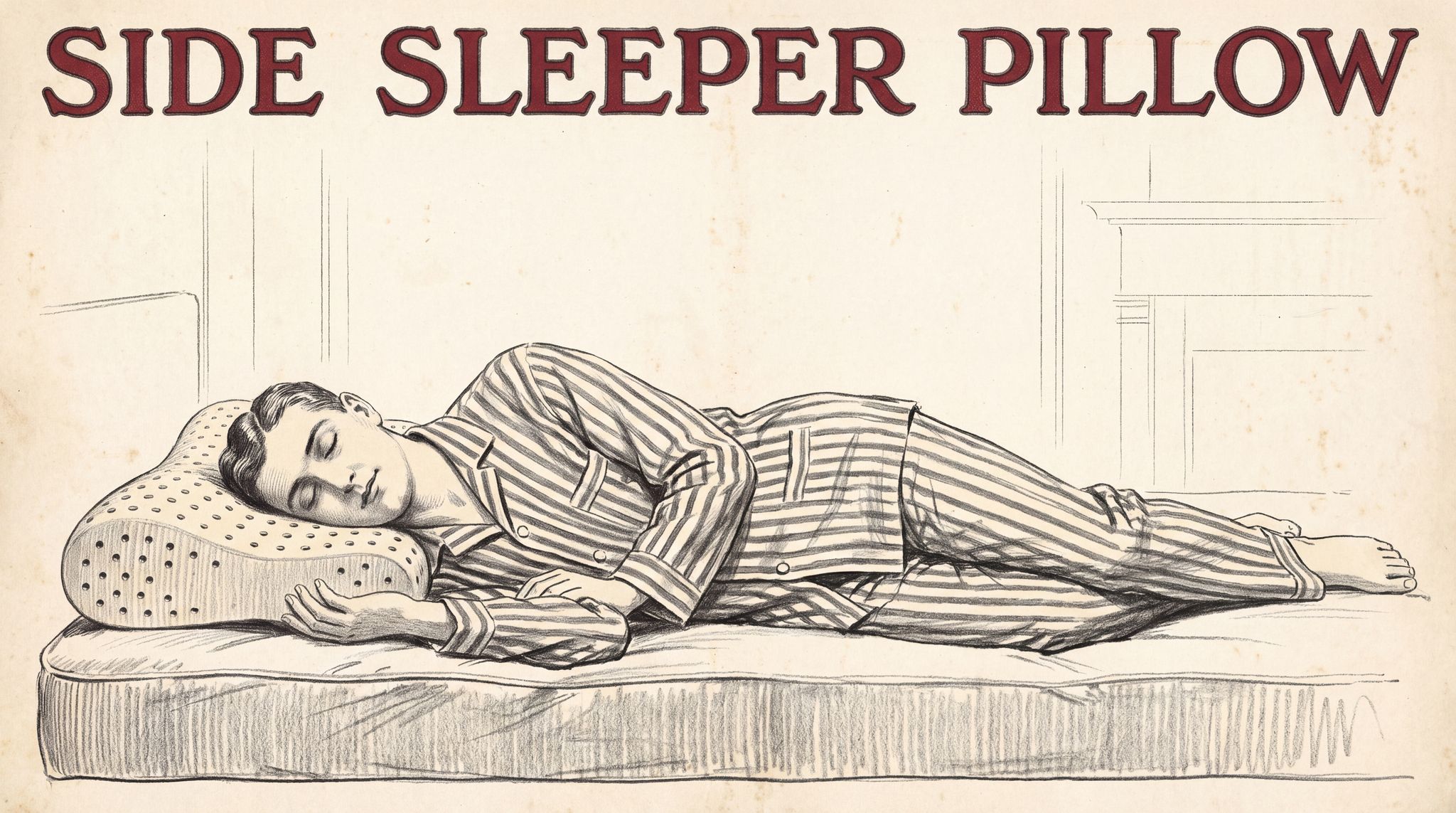
When you lie on your side, your lower shoulder holds your head up off the mattress. The pillow has to fill that gap without pushing the head up or letting it drop. In one accelerometer study, participants spent 54.1% of their time in bed in the side position, 37.5% on the back and 7.3% on the front (Skarpsno et al., 2017). Latex is a common choice because it springs back instead of slowly flattening overnight. Whether it reaches your ear depends on the pillow, your shoulders and your mattress.
Short answer: Buy by height in inches, not by the word "high" on a listing. A 2021 review found moderate evidence for a latex pillow material, a contoured pillow design (higher sides to accommodate side sleepers...) and a 7 to 11 cm (2.8 to 4.3 inch) unloaded center height (Radwan et al., 2021). A 2024 study found the right height followed each person's shoulder width (Medical & Biological Engineering & Computing, 2024). Shredded latex can be adjusted. Solid latex cannot.
This guide is for: people who sleep mostly on their side, wake up with a stiff neck or sore shoulder, and are comparing a latex pillow with the one they use now.
Key Takeaways
Three points carry most of the decision: measure your shoulder, compare heights in inches, and choose a format you can adjust if unsure.
- Measure first. In a 2024 study of 9 side sleepers, individualized pillow height was identified by a value calculated by the subject's shoulder width and absolute pillow height. That value predicted the slope of the neck with an R² of 0.80 across 4 test heights from 3.1 to 5.5 inches (8 to 14 cm) (PubMed, 2024). Shoulder width beats a size label.
- Compare inches, not labels. We read 8 seller pages on 27 September 2026. Four of them matched a height in inches to side sleepers, and those heights ran from 5 inches to roughly 7 inches. One seller calls its 5-inch pillow "high" and another sells a 5-inch pillow as "low-profile."
- The evidence favors latex, modestly. In a trial where side sleepers tried 5 pillow types for a week each, the feather pillow produced the highest frequency of waking symptoms, while the latex pillow performed best (Gordon et al., 2010). The trial did not report pillow height, so it supports the material but says nothing about size.
On This Page
The sections below run from why side sleeping needs height, through the research and listings, to fitting a pillow on your own mattress.
Each section opens with a one-line answer, then gives the figures and where they come from. Three sections have tables: one for the study heights, one for the seller listings we counted, and one with our view of each latex format. The common questions at the end cover price, weight, pillowcase size, neck pain and allergy.
Why do side sleepers need a different pillow height?
Your lower shoulder lifts your head off the mattress when you lie on your side, so the pillow must fill that gap without tilting your neck.
On the back, the head rests close to the mattress and a pillow mainly supports the curve of the neck. On the side, the geometry changes. The shoulder now sits between the mattress and the head, so the pillow has to cover the distance from the outer shoulder to the side of the head. A pillow that is too low lets the head drop toward the mattress. One that is too tall bends the neck up toward the ceiling.
Side sleeping is the most common position for adults, so this is the everyday case rather than a niche one. In a study of 363 men and 301 women, increasing age and BMI were associated with increased time in the side position (Skarpsno et al., 2017). The same study recorded on average 1.6 position shifts per hour. A side sleeper's pillow therefore also has to cope with the part of the night spent on the back.
One research team describes the main job of a pillow as holding the neck in a neutral position. That avoids more 'end-range' cervical spine postures during sleep, which are believed to increase biomechanical stresses (Gordon et al., 2010). When lying on the side, neutral means the nose, chin and breastbone sit on one straight line with the spine. Every section below is about reaching that line.
What does the research say about latex pillows for side sleepers?
One field trial in side sleepers and a 2021 review favor latex, but the studies are small and none tested every pillow shape or height.
The clearest trial recruited participants (N=106) who reported preference for side sleep position with one pillow (Gordon et al., 2009). Five experimental pillows (polyester, foam regular, foam contour, feather, and latex) were each trialed for a week, with subjects' 'own' pillow as the control (Gordon et al., 2010). About 20% of people reported waking symptoms at least once on their own pillow in the baseline week. The latex pillow performed best and the feather pillow worst, and the foam contour pillow did no better than the regular foam one.
Two reviews from 2021 point the same way. One found moderate evidence for a latex pillow material, a contoured shape, a 7 to 11 cm (2.8 to 4.3 inch) unloaded center height and a cooling surface (Radwan et al., 2021). A meta-analysis concluded that spring and rubber pillows are effective in reducing neck pain, waking symptoms, and disability in people with chronic neck pain (Chun-Yiu et al., 2021).
Read these results with care. A later paper noted that the trial's authors did not provide detailed information on their shape, height, or firmness for the pillows used (Yamada et al., 2023). The evidence says latex tends to do well. It cannot tell you which latex pillow, or what height, suits your shoulders.
How high should a latex pillow be for a side sleeper?
No single number fits everyone. The height that keeps your neck level tracks your shoulder width, so measure yourself before you shop.
Researchers agree on the principle but not on the number. A 2021 meta-analysis noted that the optimal pillow height is not necessarily correlated with individual anthropometrical dimensions such as head and shoulder width (Chun-Yiu et al., 2021). A 2024 study reached a different result. Nine side sleepers lay on latex foam pillows at four heights, and a value built from shoulder width predicted neck slope with an R² of 0.80 (PubMed, 2024).
Shoulder width is the most useful starting point a shopper has. Comfort alone is a weak guide. The 2024 study found that how comfortable a pillow felt did not track the fitted value. Sellers and reviewers often call this measurement "loft." This guide calls it height throughout.
| Source | People | Heights involved | Finding | What it means for a side sleeper (our judgement) |
|---|---|---|---|---|
| Ren et al., PeerJ 2016 | 10 | 110 to 170 mm (about four to seven inches) | Average head pressure about 30% higher on the tallest pillow than the lowest | Taller is not safer. Extra height loads the head and neck |
| Radwan et al., 2021 | Review | 2.8 to 4.3 in (7 to 11 cm) at the center, unloaded | Moderate evidence for latex and for higher sides | The center figure is for the back. The side needs the higher edge |
| 2024 side-sleeper study | 9 | 3.1, 3.9, 4.7, 5.5 in (8, 10, 12, 14 cm) | Neck slope predicted from shoulder width, R² 0.80 | Measure your shoulder before choosing |
Latex gives under the weight of a head, so treat any printed height as a starting point.
What do latex pillow listings say about height for side sleepers?
We read eight latex pillow listings and counted what each one states about height. Half matched a height in inches to side sleepers.
We read eight seller product pages for latex pillows on 27 September 2026 and counted what each one states about height. We measured nothing ourselves. The pages fell into three groups:
- 4 pages state a height in inches and say which height suits side sleepers.
- 1 page states heights in inches but ties them to preference, not sleep position.
- 3 pages mention side sleepers but give no height in inches in the text we read.
| Listing (seller page) | Height stated | Height named for side sleepers |
|---|---|---|
| Avocado Green Pillow | None in text read | Keep the fill high |
| Avocado Molded Latex Pillow | None in text read | Recommended for side sleepers |
| Brooklyn Bedding Talalay | 4 in and 5 in | 5 in |
| Deago, sold on Walmart | None; 22.8 by 15 in footprint | Side, back and stomach |
| Latex Mattress Factory Talalay | 4.5 in and 6 in | Not tied to position |
| Saatva | Roughly 4 to 5 in, 6 to 7 in | 6 to 7 in |
| Sleep365 Low-Profile | 5 in | Narrow-shouldered side sleepers |
| Sleep EZ Talalay | 4.5 and 6 in; also 5.5 and 7 in "deep" | High version |
Sellers name heights inconsistently. Brooklyn Bedding calls its 5-inch pillow high and says it is ideal for side sleepers (Brooklyn Bedding). Sleep365 sells a 5-inch pillow as low-profile and suggests it for side sleepers with narrow shoulders (Sleep365). None of the eight said whether its figure was measured with a head on the pillow.
Is solid or shredded latex better for side sleeping?
Solid latex holds one fixed height all night. Shredded latex lets you add or remove fill, which helps when you do not yet know your height.
Solid latex is one molded block. Shredded latex is loose pieces inside an inner case, usually with a zipper. For a side sleeper, the difference that matters is whether the height can change. Avocado says its molded core holds a fixed profile throughout the night, so it won't compress flat under shoulder pressure (Avocado). Its shredded pillow is different: side sleepers can keep the fill high (Avocado).
Talalay and Dunlop are two ways of making latex foam. The site's guide to Talalay, Dunlop, shredded and solid latex covers how each one feels. Format matters more than process for fit. A contour block with a raised edge can work well if that edge matches the shoulder, and the contour pillow guide explains how to check.
Size is a separate problem on American beds. The Standard Low Profile measures 25" × 16" × 4.5", while the Standard High Profile measures 25" × 16" × 6" at one seller (Latex Mattress Factory). A pillow that size sits loose in a standard American case.
| Format | Height adjustable? | Behavior under the shoulder gap | Our judgement for side sleepers |
|---|---|---|---|
| Solid, rectangular | No | Holds one fixed height | Good if you already know your height in inches |
| Solid, contour | No | Fixed, with a higher edge | Worth it only if the high edge matches your shoulder |
| Shredded latex | Yes, by fill | Pieces shift and need plumping | The safer first buy when your height is unknown |
| Shredded latex blended with another fill | Yes, by fill | Softer, depends on the blend | Try it if solid latex feels too springy |
Does your mattress change the pillow height you need?
A soft mattress lets your shoulder sink, which shrinks the gap the pillow must fill. A firm mattress keeps the shoulder high and needs more.
Many shoppers forget about mattress firmness. On a soft mattress the lower shoulder sinks further, so the gap between the mattress surface and the ear gets smaller and a lower pillow fills it. On a firm mattress the shoulder stays near the surface, and the same person needs more height. Sleep EZ says your best fit depends on your sleep position, body proportions, and how deeply you settle into your mattress (Sleep EZ). Sleep365 suggests its 5-inch pillow for anyone who sleeps on a soft mattress and needs a lower pillow to make up for it (Sleep365).
Body weight works the same way. A heavier person sinks further into the same mattress, which is one reason two people sharing a bed can need different pillows. Fit the pillow on the mattress you own, not on a showroom bed or a hard floor. A new mattress usually means a new pillow height too. With shredded latex, that means removing or adding fill instead of buying another pillow.
Rolling over adds another requirement. A side sleeper who turns onto the back needs a lower middle and a higher edge. The 2021 review described that shape as higher sides to accommodate side sleepers and a lower, flattened middle to accommodate back sleepers (Radwan et al., 2021).
How do you check the fit at home?
Lie on your side on your own mattress and have someone check that your nose, chin and breastbone form one straight line with your spine.
The check needs a second person or a phone camera and about 10 minutes. It works on any latex pillow, solid or shredded.
- Lie on one side on the mattress at home, in the usual falling-asleep position.
- Have someone stand behind, or prop a phone camera at shoulder height.
- Check that the nose, chin and breastbone form one straight line with the spine.
- If the head tilts toward the ceiling, the pillow is too tall. If it drops toward the mattress, the pillow is too low.
- With shredded latex, take out or add one handful of fill at a time and repeat. With solid latex, note the height and compare it with the other heights on offer.
Waking symptoms are the longer test. In the side-sleeper trial, waking cervical stiffness, headache and scapular/arm pain were recorded daily. The authors concluded that latex pillows can be recommended over any other type for control of waking headache and scapular/arm pain (Gordon et al., 2010). Each pillow in that trial got a full week. A week of mornings tells you more than a minute in a store. An arm that keeps going numb or tingling can have causes other than the pillow, so mention it to a clinician.
Who should not buy a latex pillow for side sleeping?
Skip latex if you or anyone sharing the bed has a latex allergy, and think twice if you sleep mostly face down or want a light pillow.
Anyone with a latex allergy should skip natural latex, and so should anyone who shares the bed with someone who has one. Allergic reactions to products made with latex develop in persons who become allergic (or sensitized) to proteins contained in natural rubber latex, and symptoms may include hives, itching, stuffy or runny nose (ACAAI). Severe reactions can be life-threatening (Cleveland Clinic). ACAAI lists health care workers, people who have had many surgeries and people with other allergies such as hay fever among those at higher risk. The site's page on what natural latex is explains where those proteins come from.
Three other groups may be better off with a different fill. People who sleep mostly face down may find that latex pillows are often too firm and too thick (Sleep Foundation). People who want a light pillow may not like latex either. One review site says the queen-size Saatva Pillow weighs 5 lb, and the king-size weighs 6 lb (Mattress Clarity). People who want to machine wash the whole pillow cannot: Avocado says the latex core itself should not be machine washed (Avocado).
Common questions
Short answers to questions side sleepers tend to ask about latex pillows, from price and weight to neck pain, allergy and pillowcase size.
Will a latex pillow fit a standard 20 by 26 inch pillowcase?
Often loosely. Latex Mattress Factory lists 25 by 16 inches (Latex Mattress Factory). A Deago pillow on Walmart measures 22.8 inches wide by 15 inches deep (Walmart).
How much does a latex pillow for side sleepers cost?
One review listed Avocado's adjustable shredded pillow at $139 and its solid molded pillow at $159 (The Good Trade). Prices change often, so check the seller's page on the day you buy.
How heavy is a latex pillow?
Heavier than most. One review site lists a queen Saatva pillow at 5 lb and a king at 6 lb (Mattress Clarity). Avocado says its shredded pillow is heavier than a typical polyester pillow (Avocado).
Can a latex pillow help neck pain?
It may help some people. A 2021 meta-analysis found that rubber pillows reduced neck pain, waking symptoms and disability in people with chronic neck pain (Chun-Yiu et al., 2021). Pain that persists calls for a clinician rather than a new pillow.
Should a combination sleeper use a side-sleeper height?
Usually a compromise works better. Adults in one study spent 54.1% of their time in bed on the side and 37.5% on the back (Skarpsno et al., 2017). A contour shape, or shredded latex set between the two heights, suits both positions.
Is a taller latex pillow always better for side sleepers?
No. People looking for the best latex pillow for side sleepers often assume more height means more support. In the 2024 study, the medium individualized height pillow with neck support showed a cervical curve closest to natural standing (PubMed, 2024). A 2016 study found average cranial pressure at the tallest pillow height approximately 30% higher than at the lowest (Ren et al., 2016).
Sources
Section 9 of this spec: references, numbered in the order they first appear, each tagged with its citing section.
- Skarpsno et al., 2017 (pubmed.ncbi.nlm.nih.gov), cited in “Why do side sleepers need a different pillow height?”; “Common questions”.
- Radwan et al., 2021 (sciencedirect.com), cited in “What does the research say about latex pillows for side sleepers?”; “How high should a latex pillow be for a side sleeper?”; “Does your mattress change the pillow height you need?”.
- Medical & Biological Engineering & Computing, 2024 (pubmed.ncbi.nlm.nih.gov), cited in “Key Takeaways”; “How high should a latex pillow be for a side sleeper?”; “Common questions”.
- Gordon et al., 2010 (pubmed.ncbi.nlm.nih.gov), cited in “Key Takeaways”; “What does the research say about latex pillows for side sleepers?”.
- Gordon et al., 2010 (tandfonline.com), cited in “Why do side sleepers need a different pillow height?”; “How do you check the fit at home?”.
- Gordon et al., 2009 (pubmed.ncbi.nlm.nih.gov), cited in “What does the research say about latex pillows for side sleepers?”.
- Chun-Yiu et al., 2021 (sciencedirect.com), cited in “What does the research say about latex pillows for side sleepers?”; “How high should a latex pillow be for a side sleeper?”; “Common questions”.
- Yamada et al., 2023 (pmc.ncbi.nlm.nih.gov), cited in “What does the research say about latex pillows for side sleepers?”.
- Ren et al., PeerJ 2016 (pmc.ncbi.nlm.nih.gov), cited in “How high should a latex pillow be for a side sleeper?”; “Common questions”.
- Avocado Green Pillow (avocadogreenmattress.com), cited in “What do latex pillow listings say about height for side sleepers?”; “Is solid or shredded latex better for side sleeping?”; “Common questions”.
- Avocado Molded Latex Pillow (avocadogreenmattress.com), cited in “What do latex pillow listings say about height for side sleepers?”; “Is solid or shredded latex better for side sleeping?”; “Who should not buy a latex pillow for side sleeping?”.
- Brooklyn Bedding Talalay (brooklynbedding.com), cited in “What do latex pillow listings say about height for side sleepers?”.
- Deago, sold on Walmart (walmart.com), cited in “What do latex pillow listings say about height for side sleepers?”; “Common questions”.
- Latex Mattress Factory Talalay (latexmattressfactory.com), cited in “What do latex pillow listings say about height for side sleepers?”; “Is solid or shredded latex better for side sleeping?”; “Common questions”.
- Saatva (saatva.com), cited in “What do latex pillow listings say about height for side sleepers?”.
- Sleep365 Low-Profile (sleep365.com), cited in “What do latex pillow listings say about height for side sleepers?”; “Does your mattress change the pillow height you need?”.
- Sleep EZ Talalay (sleepez.com), cited in “What do latex pillow listings say about height for side sleepers?”; “Does your mattress change the pillow height you need?”.
- ACAAI (acaai.org), cited in “Who should not buy a latex pillow for side sleeping?”.
- Cleveland Clinic (my.clevelandclinic.org), cited in “Who should not buy a latex pillow for side sleeping?”.
- Sleep Foundation (sleepfoundation.org), cited in “Who should not buy a latex pillow for side sleeping?”.
- Mattress Clarity (mattressclarity.com), cited in “Who should not buy a latex pillow for side sleeping?”; “Common questions”.
- The Good Trade (thegoodtrade.com), cited in “Common questions”.