Is a natural latex pillow worth it?
Updated .
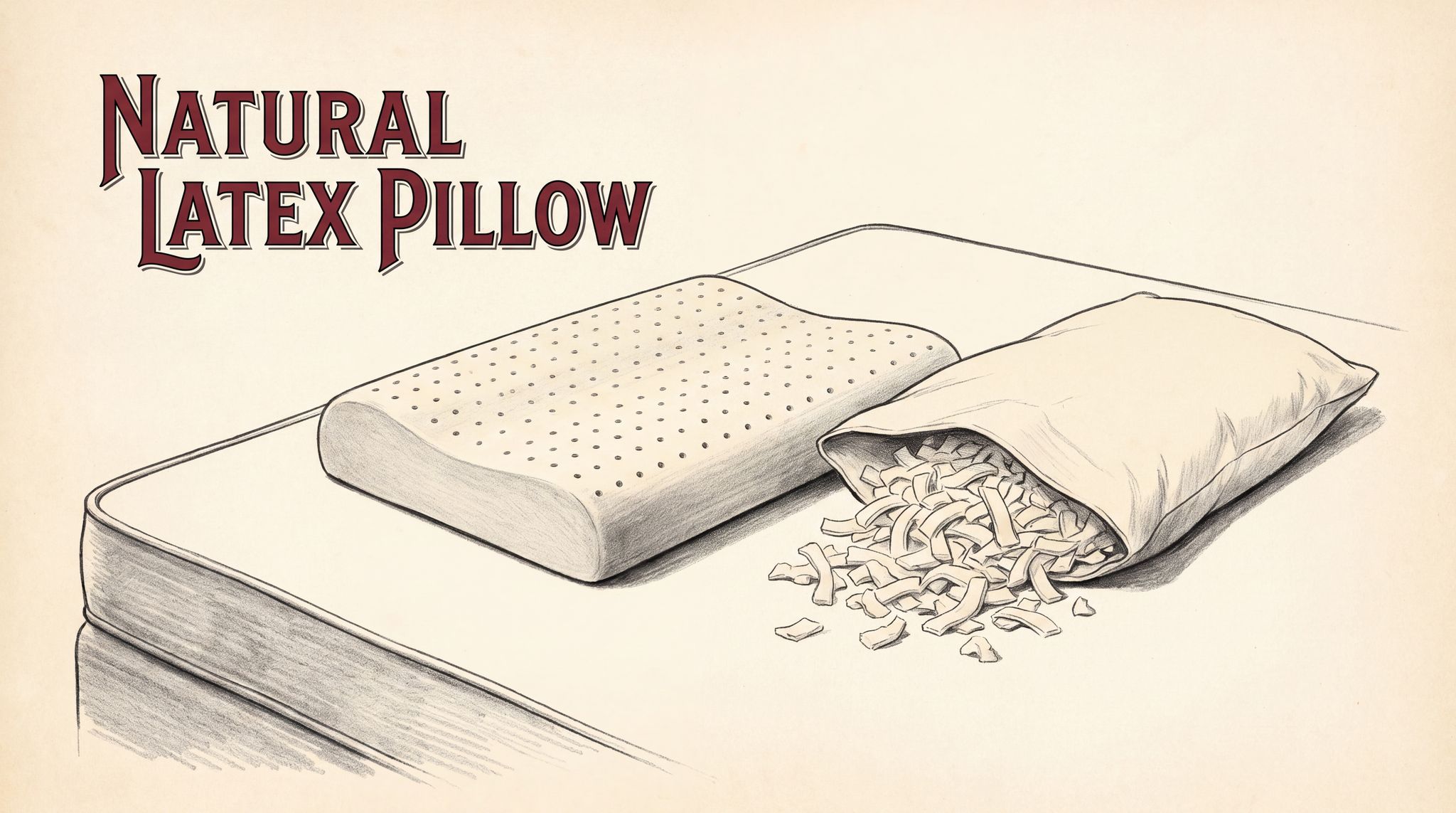
A natural latex pillow is springy foam made from rubber tree sap, and a buyer pays for that spring in weight and size. The standard-size ones we read weigh 3 to 4 pounds. A molded standard is listed at 25 by 16.5 by 5 inches and 3.1 pounds (Avocado), and a shredded standard at 15 by 22 by 5 inches and 4 pounds (Turmerry). Neither one is as wide as the 20 by 26 inch case on most American beds (HomeCalcy). For the sleeper, that means a heavy pillow that holds its shape but sits loose in a normal case unless the case is bought to match.
Short answer: Yes, for people who want a pillow that keeps its height and have no latex allergy. A 2021 review of thirty-five studies found rubber pillows reduced neck pain but made no difference to sleep quality (Sleep Advances, 2021). Shredded fill suits people who want to set the height themselves, and a solid block suits people who want one fixed shape. Only call a pillow organic when its latex carries GOLS, which requires more than 95% certified organic raw material (Avocado Help Center).
This guide is for: people in the United States weighing a natural or organic latex pillow who want the evidence, the labels and the sizes checked before they buy one.
Key Takeaways
Three findings carry the rest of this page: what the evidence shows, what the labels prove, and what size you are paying for.
- The neck-pain evidence is real but small. A 2021 meta-analysis took in 35 articles, 9 of them high-quality studies covering 555 people. It favored rubber pillows for neck pain, but pillow design made no measurable difference to sleep quality.
- Only one label checks the latex. GOLS requires more than 95% certified organic raw material. Just 7 of the 18 product pages we read on 26 September 2026 named GOLS for the latex inside the pillow.
- Standard does not mean 20 by 26. The standard-size latex pillows we read ran 15 to 16.5 inches wide. That is 3.5 to 5 inches narrower than the US case they are sold to go into, so the case fits loosely.
On This Page
Each question below links to its section, in the order the sections appear, from what the pillow is made of to who should skip one.
What is a natural latex pillow made of?
A natural latex pillow is foam made from rubber tree sap, sold either as one molded block or as loose shredded pieces inside a zippered cover.
Natural latex starts as the sap of the Brazilian rubber tree (Hevea brasiliensis), which is used in manufacturing latex products (New York State Department of Health). Factories turn that sap into foam in one of two ways, and the method shapes the feel. Talalay latex is flash-frozen at -22°F (-30°C), then heated to 220°F (104°C) to turn it solid (Avocado). Dunlop latex skips the freezing step: it is baked in a mold and comes out firmer, while the freezing step gives Talalay a springier feel (Sleep Junkie).
The finished pillow comes in two forms: one molded block or loose shredded pieces. Blocks are usually punched with pinholes so air can move through them. Shredded fill is not always one type of latex. One seller says its shredded fill may include a mix of Dunlop latex, Talalay latex, and Talalay infused latex pieces (Latex Mattress Factory).
A pillow sold as natural can still hold synthetic rubber. The FTC found that a mattress sold with a "Natural Latex Core" in truth used synthetic latex (FTC, 2017). The label section below shows what to check. For how the sap is tapped and cured, see what natural latex is.
Does a latex pillow help neck pain?
The trials favor latex over feather and polyester for waking neck pain, but the effect is small and pooled data showed no gain in sleep quality.
The evidence leans toward latex. In a blinded field trial, side-sleepers using one pillow tried polyester, regular foam, contour foam, feather and latex pillows for a week each (Gordon et al., 2010). Feather produced the most waking symptoms and latex performed best, and the authors recommended latex for waking headache and shoulder or arm pain.
A 2021 review pooled the trials. It found thirty-five eligible articles, including nine high-quality studies involving 555 participants (Sleep Advances, 2021). Rubber pillows reduced neck pain, but pillow design did not change sleep quality.
| Study | Design | Who took part | What it found |
|---|---|---|---|
| Gordon et al., 2010 | Blinded field trial, 5 pillows, 1 week each | Side sleepers not in neck treatment | Latex had the fewest waking symptoms, feather the most |
| Radwan et al., 2021, as reported in a later study | Systematic review | Trials of pillow material, height, shape and cooling | Moderate evidence for latex material and a 7 to 11 cm height |
| Sleep Advances, 2021 | Meta-analysis | Nine high-quality studies, 555 people | Rubber pillows cut neck pain; no effect on sleep quality |
Height may matter as much as the fill. That same systematic review found moderate evidence for a latex pillow material, a contoured design and a pillow height of a little under 3 inches to just over 4 inches (7 to 11 cm) (pillow-height study, PMC). Height deserves a check before the material takes the blame.
Should you choose a shredded or a solid latex pillow?
Choose shredded if you want to set the height yourself; choose solid if you want one fixed shape that springs back the same way every night.
The choice turns on whether you already know the height you need. A shredded pillow lets you add or remove fill to customize height and firmness (Naturepedic). A solid pillow stays as made. One seller notes that a solid latex pillow locks you into one height, while shredded fill can be adjusted months later (Latex Mattress Factory).
| Shredded | Solid | |
|---|---|---|
| Height | Set by adding or removing fill | Fixed at the stated height |
| Feel | Softer, shifts under the head | Springs back in one piece |
| Refill | Top up with loose fill | Cannot be refilled |
| Suits (our judgement) | People unsure of their height | People who know the height that keeps their neck level |
The two forms also differ in size, even when both are sold as standard. The shredded standard we read is 15 inches wide (Turmerry), and the molded standard is 16.5 inches wide (Avocado). Compare the stated dimensions, not just the form. For anyone unsure, shredded is the safer first buy, because fill can always come out. Our longer comparison of Talalay, Dunlop, shredded and solid is in the latex pillow guide.
What do the labels on an organic latex pillow prove?
Only GOLS checks that the latex itself is organic; a harmful-substance label tests for chemicals, and "100% natural" alone is the seller's word.
GOLS is the only label here that checks organic content. To qualify, a product must contain more than 95% certified organic raw material sourced from organic rubber plantations certified to USDA NOP or EU organic standards (Avocado Help Center). The standard also sets limits for harmful substances, emissions, polymers and fillers, and tracks each sale from plantation to retailer (Control Union). It has one limit. A maker can hold a GOLS licence and still sell pillows that are not certified, so check that the certificate names the pillow you are buying.
| Words on the page | What it checks | What it does not tell you (our reading) |
|---|---|---|
| GOLS | Latex is over 95% certified organic; harmful substances and fillers are limited | That the cover or the whole pillow is organic |
| OEKO-TEX Standard 100 | Free of harmful substances | Whether the latex is natural, organic or blended |
| FSC | How the rubber-tree forest is managed | Organic content or chemical residue |
| "100% natural" with no certificate | Nothing beyond the seller | Anything an outside body has checked |
A certificate protects the buyer, because sellers have paid for unchecked claims before. In 2013 the FTC settled three mattress cases over unsupported claims of being free of VOCs, and challenged one company's claim that its mattresses were made from 100 percent natural materials (FTC, 2013). When a page says organic, ask the seller for the GOLS certificate, so the pillow on the bed matches the claim on the page.
What did the product pages we read claim about their latex?
We read 18 US product pages on one day and sorted them by what they named for the latex: GOLS, another label, or no label at all in the text.
We read 18 US product pages for natural or organic latex pillows on 26 September 2026, using the text each page showed that day. We sorted each page by what it named for the latex itself, not for the cover. The latex pillows we pick were bought and handled, but every entry here rests on seller text alone. This is a count of what sellers state, and our method page sets out the rules. One page offered GOLS or FSC latex depending on the option; we counted it under GOLS.
| What the page named for the latex | Pages | Examples we read |
|---|---|---|
| GOLS | 7 | Turmerry, My Organic Sleep, The Clean Bedroom |
| Another label only (OEKO-TEX or FSC) | 4 | Sleep On Latex (linked in the size table below) |
| No label for the latex | 7 | PlushBeds, FloBeds, Bear |
Pages at both ends of the table described their latex as "100% natural." It appeared on a GOLS page (Latex Mattress Factory) and on a page naming no label, where the pillow is described as solid 100% natural talalay latex (PlushBeds). So the phrase sorts nothing. A page in the third bucket may still hold a certificate as an image or file we did not read. Treat that bucket as unverified, not as uncertified.
Will a latex pillow fit a 20 by 26 inch pillowcase?
The latex pillows we read that are sold as standard run 15 to 16.5 inches wide, so a 20 by 26 inch case fits them loosely at the sides.
A US standard pillow is 20 × 26 inches, queen is 20 × 30 and king is 20 × 36 (HomeCalcy). Latex pillows often run smaller. The sizes below come from sellers' own pages. The fit column is our judgement from those sizes, and no seller publishes it.
| Pillow page | Sold as | Stated size (inches) | Stated weight | How the matching US case fits (our judgement) |
|---|---|---|---|---|
| Turmerry shredded | Standard | 15 x 22 x 5 | 4 lb | Loose on width and length |
| Avocado molded | Standard | 16.5 x 25 x 5 | 3.1 lb | Loose on width, close on length |
| PlushBeds | Standard | 16 x 25 x 4.5 | 3 lb | Loose on width, close on length |
| Sleep On Latex | One size, queen case | 15 x 27 x 6.5 | Not stated | Loose on width and length |
A loose case lets the pillow slide around, and the spare fabric bunches under the cheek. Buy the case to fit the pillow, not the bed. Height is the other number to check. Pillow depth is not standardized at all and runs from about 3 in to 8 in (HomeCalcy), and the pages above list 4.5 inches (PlushBeds) to 6.5 inches (Sleep On Latex).
How much latex fill does a shredded pillow need?
One kit seller lists 4.5 pounds of fill for a 20 by 26 inch shredded pillow; start full, lie down, and remove handfuls until the neck is level.
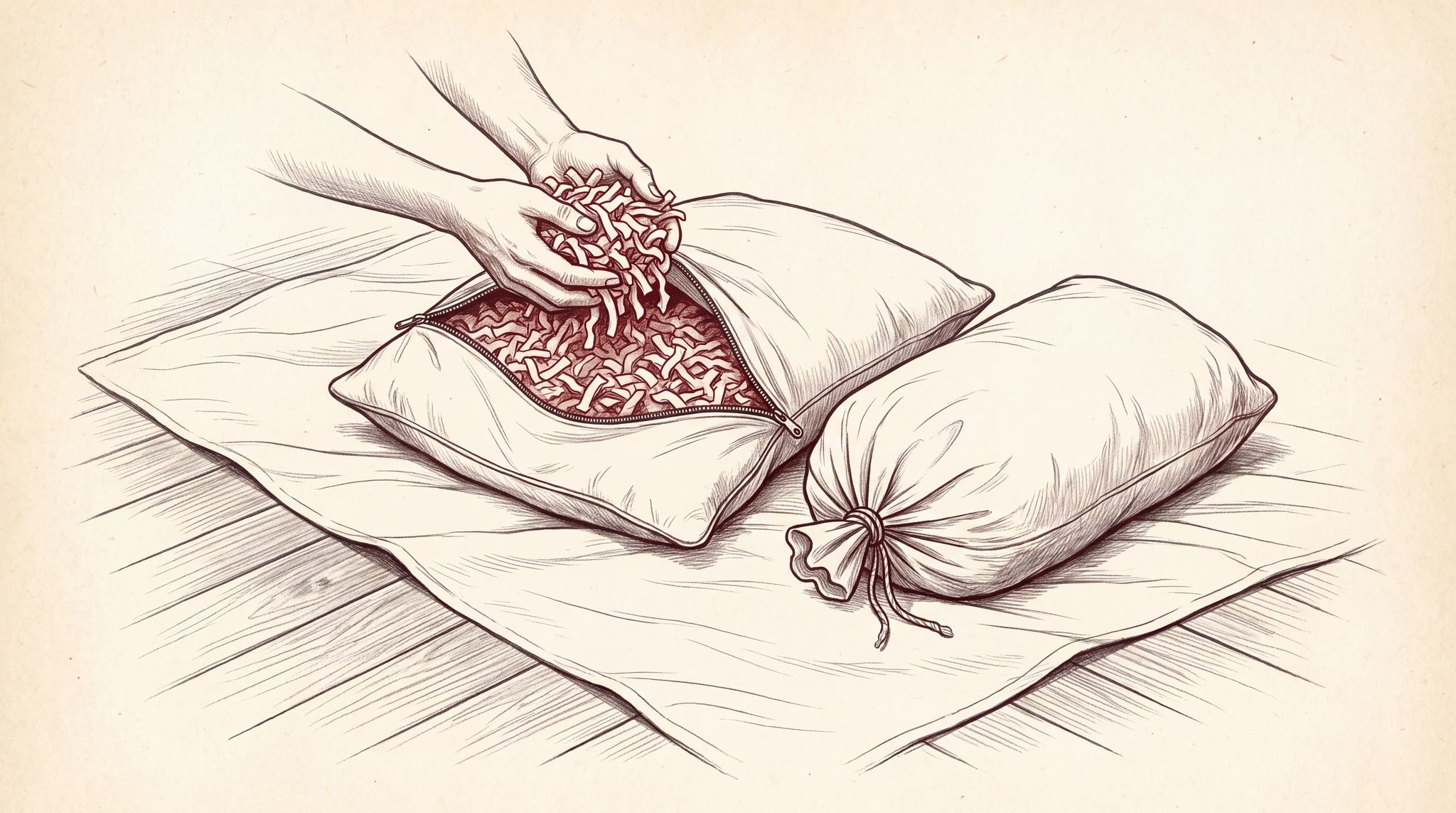
One pillow kit seller lists 4.5 pounds of fill for a 20 by 26 inch standard, 6 pounds for a queen and 7 pounds for a king (DIY Natural Home). A pillow cut narrower than the case holds less. One 15 by 22 inch shredded standard is listed at 4 pounds (Turmerry).
To set yours:
- Start with the pillow full, as it shipped.
- Lie in the usual sleeping position for about five minutes.
- Take out one handful at a time until the head sits level with the spine.
- Keep the spare fill in a sealed bag for later top-ups.
Some pillows arrive with 1 bag of extra shredded latex fill for this job (Naturepedic). Work over a sheet on a hard floor, since loose pieces scatter when the cover is open. People who sleep on their side usually need more fill than people who sleep on their back, since the shoulder leaves a wider gap under the head. Go slowly, because fill is easier to take out than to put back.
Who should skip a latex pillow?
Anyone with a diagnosed latex allergy should skip it, and so should people who want a pillow they can fold, squash or wash whole in a machine.
A diagnosed latex allergy is the clear reason to skip. If someone sensitive to the sap protein touches or breathes it, the reaction can range from a simple skin rash to shock, which is rare (New York State Department of Health). Estimates of how common it is disagree. One clinical reference says latex allergy affects 1 to 2 percent of the population, with health care workers more likely to be sensitized (StatPearls, NCBI Bookshelf). A separate review gives a worldwide allergy figure of 4.3% (PMC review). Anyone who reacts to latex gloves or balloons should ask a doctor before buying.
Other reasons come down to habits, not health. You cannot machine-wash the latex core, and one maker says the inner pillow is spot clean only (Naturepedic). Our care notes cover cleaning in more detail. A solid block will not fold in half or squash into a new shape, and some people rely on doing that every night. Weight counts too. The standard pillows in our size table weigh 3 to 4 pounds, which is heavy to shift around the bed.
Price is the last check. One seller says its shredded pillow can last 5+ years with proper care (Turmerry), so weigh the price against that claim rather than against a single season. If you want a pillow to hug, fold and throw in the washer, a latex one will frustrate you.
Common questions
Short answers to common questions about latex pillows, from washing the latex core to how long the warranties we read last.
Can you wash a latex pillow?
Wash the cover, not the latex. One seller says the latex core should not be washed, while the outer organic cotton cover is removable and machine washable (My Organic Sleep). Spot clean the core and let it dry fully.
How long does a latex pillow last?
No trial we found measured it. Warranties give you a floor instead: a 3-year warranty on one line (PlushBeds) and a 5-year warranty on another (Sleep On Latex).
Is Talalay or Dunlop better for a pillow?
Neither wins in general. Dunlop is baked in a mold and feels firmer, while Talalay is frozen then baked and feels springier (Sleep Junkie). Pick by feel.
Does a latex pillow sleep cool?
Sellers say so and point to pinholes and open cells. We found no study that measured pillow surface temperature, so treat it as a claim.
Are latex pillows resistant to dust mites?
Sellers claim it, and several product pages repeat it. We found no published study of mite allergen inside a latex pillow, so the claim rests on the sellers alone.
Is an organic latex pillow different from a natural one?
It should be. Organic means the latex carries GOLS and its more-than-95% rule. Natural has no set test, so you have to ask the seller what backs it up.
Sources
Section 9 of this spec: references, numbered in the order they first appear, each tagged with its citing section.
- Avocado (avocadogreenmattress.com), cited in “Should you choose a shredded or a solid latex pillow?”; “Will a latex pillow fit a 20 by 26 inch pillowcase?”.
- Turmerry (turmerry.com), cited in “Should you choose a shredded or a solid latex pillow?”; “What did the product pages we read claim about their latex?”; “Will a latex pillow fit a 20 by 26 inch pillowcase?”; “How much latex fill does a shredded pillow need?”; “Who should skip a latex pillow?”.
- HomeCalcy (homecalcy.com), cited in “Will a latex pillow fit a 20 by 26 inch pillowcase?”.
- Sleep Advances, 2021 (pmc.ncbi.nlm.nih.gov), cited in “Does a latex pillow help neck pain?”.
- Avocado Help Center (help.avocadogreenmattress.com), cited in “What do the labels on an organic latex pillow prove?”.
- New York State Department of Health (health.ny.gov), cited in “What is a natural latex pillow made of?”; “Who should skip a latex pillow?”.
- Avocado (avocadogreenmattress.com), cited in “What is a natural latex pillow made of?”.
- Sleep Junkie (sleepjunkie.com), cited in “What is a natural latex pillow made of?”; “Common questions”.
- Latex Mattress Factory (latexmattressfactory.com), cited in “What is a natural latex pillow made of?”; “Should you choose a shredded or a solid latex pillow?”; “What did the product pages we read claim about their latex?”.
- FTC, 2017 (ftc.gov), cited in “What is a natural latex pillow made of?”.
- Gordon et al., 2010 (pmc.ncbi.nlm.nih.gov), cited in “Does a latex pillow help neck pain?”.
- Radwan et al., 2021, as reported in a later study (pmc.ncbi.nlm.nih.gov), cited in “Does a latex pillow help neck pain?”.
- Naturepedic (naturepedic.com), cited in “Should you choose a shredded or a solid latex pillow?”; “How much latex fill does a shredded pillow need?”; “Who should skip a latex pillow?”.
- Control Union (controlunion.com), cited in “What do the labels on an organic latex pillow prove?”.
- FTC, 2013 (ftc.gov), cited in “What do the labels on an organic latex pillow prove?”.
- My Organic Sleep (myorganicsleep.com), cited in “What did the product pages we read claim about their latex?”.
- The Clean Bedroom (thecleanbedroom.com), cited in “What did the product pages we read claim about their latex?”.
- PlushBeds (plushbeds.com), cited in “What did the product pages we read claim about their latex?”.
- FloBeds (flobeds.com), cited in “What did the product pages we read claim about their latex?”.
- Bear (bearmattress.com), cited in “What did the product pages we read claim about their latex?”.
- PlushBeds (plushbeds.com), cited in “Will a latex pillow fit a 20 by 26 inch pillowcase?”; “Common questions”.
- Sleep On Latex (sleeponlatex.com), cited in “Will a latex pillow fit a 20 by 26 inch pillowcase?”; “Common questions”.
- DIY Natural Home (diynaturalhome.com), cited in “How much latex fill does a shredded pillow need?”.
- StatPearls, NCBI Bookshelf (ncbi.nlm.nih.gov), cited in “Who should skip a latex pillow?”.
- PMC review (pmc.ncbi.nlm.nih.gov), cited in “Who should skip a latex pillow?”.
- My Organic Sleep (myorganicsleep.com), cited in “Common questions”.